What do South Metro Denver sellers need to know about wildfire mitigation and defensible space certifications before listing their home?
If you own a home in Douglas County’s wildland-urban interface, you need to understand the new Colorado Wildfire Resiliency Code, your defensible space obligations, and how insurance scoring affects your sale before you ever plant a sign in the yard.
Why Wildfire Mitigation Matters for Douglas County Sellers Right Now
Here is the reality: Colorado’s Wildfire Resiliency Code took effect on July 1, 2026, and Douglas County adopted it on that same date. If you are planning to sell your home in Castle Rock, Franktown, Lone Tree, or anywhere in the South Metro area that falls within a mapped wildland-urban interface zone, this code changes the conversation between you, your buyer, and that buyer’s insurance company.
With 30 years of experience in the Douglas County market and over 469 closed transactions, what I can tell you is that wildfire mitigation has moved from a “nice to have” to a deal-level factor. Buyers relocating to Colorado from states without significant wildfire exposure often do not know what to ask, but their lenders and insurers absolutely do. Sellers who get ahead of this stand out in a market where the median sale price sits at $720,000, per LocalAlpha data as of August 2026, and where buyers are scrutinizing every detail before writing offers.
How Colorado’s New Wildfire Resiliency Code Affects Your Douglas County Home Sale
You might have heard about Senate Bill 23-166, passed in 2023. The law created Colorado’s statewide wildfire resiliency code process. The Wildfire Resiliency Code Board adopted the final code on July 1, 2025, and every jurisdiction with land in the wildland-urban interface had to adopt it, or something meeting or exceeding it, by April 1, 2026, with enforcement beginning July 1, 2026. This represents a significant shift in how Colorado real estate transactions must address fire safety.
What This Means If You Are Selling, Not Building
Here is the critical nuance. The code is a building code for new construction, not a retroactive requirement on your current home. However, according to Colorado’s Division of Insurance guidance on wildfire protection, several factors make compliance important for sellers:
- If you completed any renovation or improvement work and pulled permits after July 1, 2026, those permits may have triggered wildfire-resilient construction and defensible space requirements.
- Buyers and their agents will increasingly ask whether your home meets current standards, even if you are not legally required to comply.
- Insurance companies are already using aerial imagery and third-party wildfire risk models to flag properties, regardless of the building code, according to Colorado’s Division of Insurance.
The practical takeaway: even though the code does not force you to retrofit your existing home, the market is treating compliance as a competitive advantage. In my experience helping sellers across Douglas County, the homes that sell with fewer headaches are the ones where the seller can hand a buyer a clear picture of what has been done.
Understanding Defensible Space Zones in Castle Rock and Franktown
Douglas County, Boulder County, and the city of Colorado Springs all have their own wildland-urban interface codes with different clearance distances, roofing requirements, and permit triggers. If your property sits in the WUI overlay district, here is the three-zone framework the Colorado State Forest Service recommends and that most local jurisdictions follow:
- Zone 1 (0 to 5 feet from the structure): No combustible materials. No wood mulch. Clean roof and gutters. Nonflammable landscaping only.
- Zone 2 (5 to 30 feet): Low-fuel plants or maintained lawn. Trees spaced and pruned to eliminate ladder fuels. This is the zone insurance inspectors focus on most heavily.
- Zone 3 (30 to 100+ feet): Thinned trees, reduced dead fuel, and spacing between tree crowns to slow fire spread.
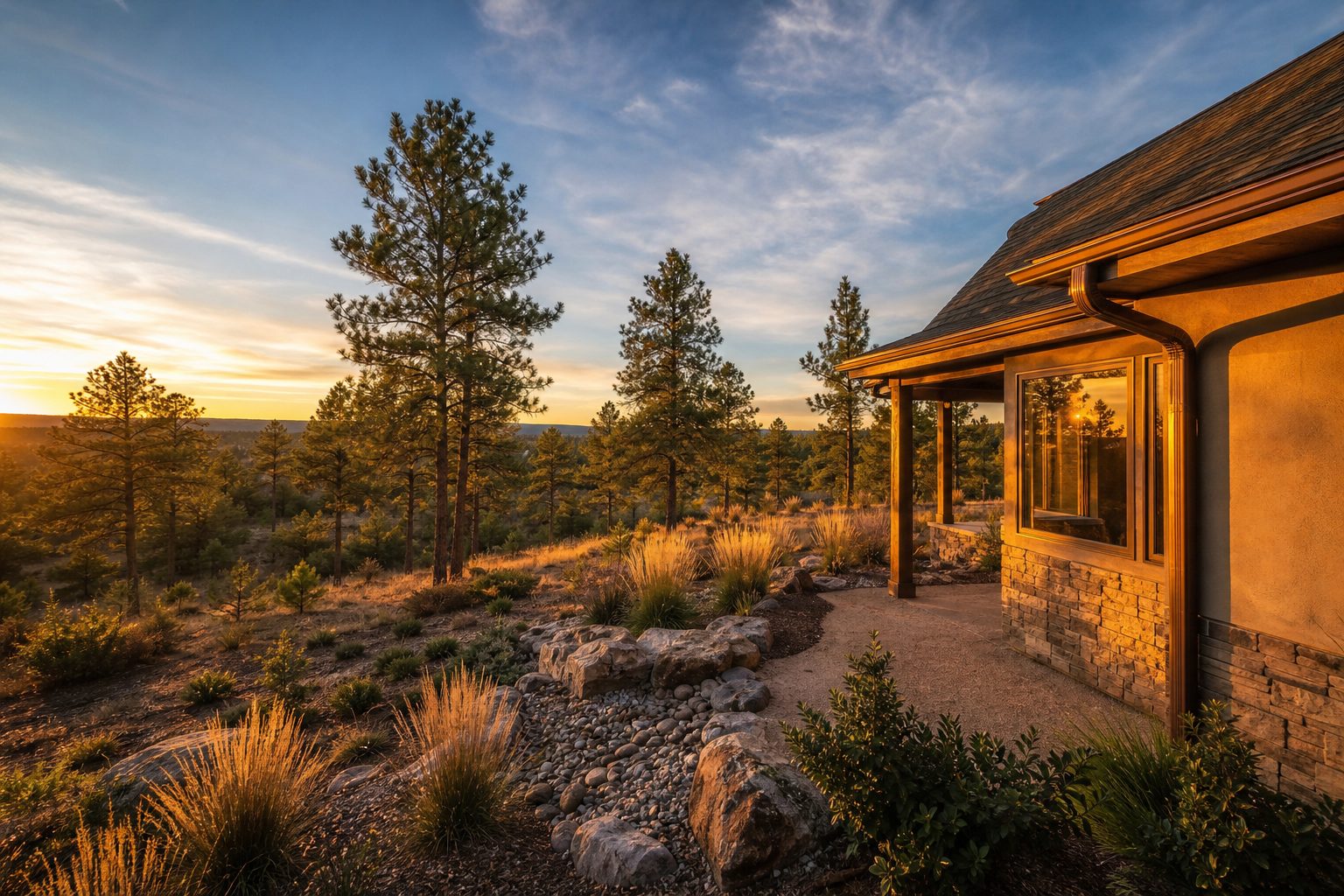
So what does this actually look like for you? If you own five acres outside Franktown with mature Ponderosa pines tight against your roofline, Zone 1 and Zone 2 work is not optional from a marketability standpoint. Buyers relocating from the West Coast or from states without wildfire risk may not initially understand these zones, but their insurance company will evaluate them during the underwriting process.
Costs for defensible space work generally run $1,000 to $5,000 or more, per Colorado State Forest Service estimates. That range depends on lot size, tree density, and whether you need professional tree removal versus basic brush clearing.
How Wildfire Risk Scoring Affects Your Ability to Close a Sale in Douglas County
This is the section that catches many sellers off guard. Wildfire mitigation is not just about safety. It is about whether your buyer can obtain affordable homeowner’s insurance and close the transaction.
What Insurance Companies Are Looking At
Insurance wildfire inspections in Colorado generally evaluate:
- Roof condition and material (Class A fire-rated roofing preferred)
- Defensible space within 30 feet, often scored by percentage of clearance achieved
- Vent screening to prevent ember entry
- Deck and porch construction materials
- Proximity of trees and shrubs to the structure
- Presence of a visible address sign from the road
Your New Rights as a Homeowner
Effective July 1, 2026, you can now ask your insurer for your written wildfire risk score, and they are required to provide it within 15 days, according to Colorado’s Division of Insurance. If you have completed mitigation work, document everything. You now have a legal basis to request a discount or model adjustment from your carrier.
What I tell my clients is this: get your wildfire risk score before you list. If the score is favorable, it becomes a selling point. If it is not, you have time to address the issues rather than discovering them when a buyer’s insurance application gets denied three weeks before closing.
Colorado law also requires insurers to give 60 days’ notice before non-renewing a homeowner’s policy for wildfire risk. If your policy has been non-renewed, that is a disclosure issue a buyer will discover. Get in front of it.
Preparing Your Douglas County Home for a Wildfire-Smart Listing
With Douglas County’s median days on market at 21 days, up 16.7% year over year as of August 2026 per LocalAlpha, you have a slightly wider window than you did last year, but first impressions still matter. Here is what moves the needle:
Pre-Listing Mitigation Checklist
- Get your wildfire risk score in writing from your current insurer.
- Complete Zone 1 and Zone 2 defensible space work. Document it with photos and receipts.
- Replace wood-shake roofing with Class A fire-rated material if applicable.
- Screen all exterior vents with 1/8-inch metal mesh.
- Clear gutters, eaves, and dead vegetation from within five feet of the structure.
- Check whether your community has Firewise USA certification. The National Fire Protection Association’s Firewise USA program certifies communities that complete collective defensible-space work and maintain a community wildfire protection plan. Colorado has dozens of recognized Firewise communities, per the Colorado State Forest Service, and living in one signals reduced risk to buyers and insurers.
What Relocation Buyers Do Not Know
Buyers moving to Colorado from non-wildfire states often do not understand WUI designations, defensible space zones, or why their insurance quote came back higher than expected. When you can present a clean mitigation file at the kitchen table, you eliminate one of the biggest sources of buyer anxiety in a WUI-area transaction. Rated 5 out of 5 stars across 130 client reviews, the feedback I consistently receive is that proactive preparation builds trust and moves deals forward.
Douglas County Market Context: Why Mitigation Is a Competitive Edge
Douglas County remains a balanced market with an Alpha Score of 42 out of 100 as of August 2026, per LocalAlpha. Months of supply sit at 2.9, and homes for sale totaled 1,812, down 14.2% year over year. That is still tighter than the broader Denver metro, where supply has grown to roughly 20 weeks according to REcolorado data from September 2026.
What does that mean for your listing strategy? Douglas County sellers have less competition than metro-core sellers, but buyers are more selective. A home at the $720,000 median price point with documented wildfire mitigation will stand out against one without it, especially when insurance underwriting becomes the buyer’s bottleneck.
The forecast model from LocalAlpha projects Douglas County home prices to rise about 2.0% over the next 12 months with high confidence. Investing $1,000 to $5,000 in defensible space work to protect a transaction on a $700,000-plus asset is not a cost. It is insurance for your closing.
Frequently Asked Questions
Does Douglas County require defensible space certification before I can sell my home?
No. Colorado does not have a statewide law requiring a defensible space certification at the point of sale. However, Douglas County does have WUI overlay district regulations with specific vegetation clearance and roofing standards. Even without a mandatory pre-sale certification, your buyer’s insurance company will evaluate defensible space during underwriting, making voluntary compliance essential for a smooth closing.
When did the Colorado Wildfire Resiliency Code take effect in Douglas County?
Douglas County adopted the Colorado Wildfire Resiliency Code effective July 1, 2026. The code applies to building permits submitted on or after that date for new construction and certain renovation projects within mapped WUI areas. It does not retroactively require existing homeowners to retrofit, but it sets the standard buyers and insurers reference.
How much does defensible space work cost in the Castle Rock area?
According to Colorado State Forest Service estimates, defensible space work typically costs $1,000 to $5,000 or more depending on your lot size, tree density, and the scope of clearing required. Properties with heavy Ponderosa pine coverage on larger lots in areas like Franktown or the outskirts of Castle Rock tend to fall toward the higher end of that range.
Can my homeowner’s insurance be canceled because of wildfire risk?
Yes. Colorado’s Division of Insurance has acknowledged rising non-renewal rates tied to wildfire risk scoring. Insurers must give you 60 days’ notice before non-renewing your policy for wildfire risk under Colorado law. If you have received a non-renewal notice, address mitigation immediately and disclose the situation to your listing agent.
How do I get my wildfire risk score from my insurance company?
As of July 1, 2026, you can request your written wildfire risk score from your insurer, and they are required to provide it within 15 days, per Colorado’s Division of Insurance. Contact your carrier in writing and specifically request your wildfire risk score and the model used to generate it.
What are the three defensible space zones recommended for Douglas County homes?
The Colorado State Forest Service recommends Zone 1 (0 to 5 feet with nonflammable materials), Zone 2 (5 to 30 feet with low-fuel plants and spaced trees), and Zone 3 (30 to 100-plus feet with thinned trees and reduced dead fuel). Douglas County’s WUI overlay district follows this general framework.
Do I need to disclose wildfire risk when selling my Douglas County home?
Colorado’s seller disclosure obligations require you to disclose known material facts about the property. If your home is in a mapped WUI zone, has received an insurance non-renewal, or has known wildfire mitigation deficiencies, these are facts a buyer needs to know. Proactive disclosure protects you legally and builds buyer confidence.
What is a Firewise USA community, and does it help my home’s value?
Firewise USA is a National Fire Protection Association program that certifies communities performing collective defensible-space work and maintaining wildfire protection plans. Colorado has dozens of recognized Firewise communities, per the Colorado State Forest Service. Living in one signals lower community-level risk to insurers and can support more favorable insurance terms for buyers.
Will the Wildfire Resiliency Code require me to retrofit my existing home?
No. The code applies to new construction and building permits submitted on or after July 1, 2026. It is not retroactive. However, if you pull a permit for a major renovation, addition, or remodel in a WUI area, the new code requirements may be triggered for that project.
How does wildfire mitigation affect my listing price in Douglas County?
There is no published premium percentage for wildfire-mitigated homes specifically. However, in a market where the median sale price is $720,000 as of August 2026 per LocalAlpha and buyer scrutiny is increasing, documented mitigation work removes a significant objection. It helps your home appraise, insure, and close without delays that can crater a deal.
The Bottom Line
If you are selling a home in Douglas County or anywhere in the South Metro Denver corridor, wildfire mitigation is no longer optional from a practical standpoint. The new Colorado Wildfire Resiliency Code is live, insurers are scoring your property whether you ask them to or not, and buyers, especially those relocating to Colorado, need reassurance backed by documentation.
Get your wildfire risk score. Complete your defensible space work. Keep every receipt and photo. These steps protect your transaction, your timeline, and your bottom line. With 30 years in this market and 469 closed transactions across Douglas County, I can tell you that the sellers who prepare are the ones who close on schedule. If you have questions about how wildfire mitigation affects your specific property, call me at 303-882-7706 or visit DavidRichins.com. Let’s get your home positioned to sell with confidence.