What are the real differences in privacy, security, and HOA structure between Village at Castle Pines, BackCountry in Highlands Ranch, and Keepers Ridge in Lone Tree?
Village at Castle Pines delivers the highest level of gated security with five staffed entry points and 40 full-time emergency services professionals. BackCountry operates a single gatehouse with transponder access, and Keepers Ridge offers a newer, smaller-community feel with its own access controls. Your monthly costs, lifestyle restrictions, and day-to-day privacy vary significantly across all three.
Why This Comparison Matters for South Denver Metro Buyers and Sellers Right Now
If you are relocating to Colorado or moving up within Douglas County, you have probably already noticed that “gated community” means very different things depending on which neighborhood you are evaluating. The differences are not cosmetic. They affect your monthly expenses, your daily routines, and even how your guests and deliveries reach your front door.
Douglas County is currently classified as a balanced market with an Alpha Score of 42 out of 100, as of August 2026 per LocalAlpha data. The median sale price across the county sits at $720,000, but Castle Pines Village operates in an entirely different tier, with a median sale price of $1.6 million over the May through August 2026 period according to local MLS data. With 30 years of experience helping buyers and sellers navigate these exact communities, I can tell you that the choice between these three neighborhoods comes down to how much structure you want around your privacy and what you are willing to pay for it monthly.
Security in Castle Pines Village Compared to BackCountry and Keepers Ridge
This is where the three communities diverge most sharply, and it is the first question I get from almost every relocation buyer.
Castle Pines Village: Five Staffed Gates and In-House Emergency Services
Village at Castle Pines operates five staffed entry gates. Gate 1 is staffed 24 hours a day, 365 days a year. Gates 2 through 5 are staffed from 6:30 a.m. to 10:00 p.m., per the Castle Pines Homes Association. What makes this community distinct in all of Douglas County is the 40 full-time Castle Pines Emergency Services (CPES) professionals who handle gate access control, patrols, alarm monitoring, traffic enforcement, and vehicle access support. This is not a contracted security company. This is an in-house team funded directly by homeowner dues that supplements Douglas County services and South Metro Fire Rescue.
What does that mean in practice? Every contractor, delivery driver, and guest must be pre-cleared before they reach your property. If you live off Le Duc Drive or in one of the cul-de-sac pockets near Maroon Peak Place, you will not see unannounced visitors. Period.
BackCountry: Single Gatehouse, Transponder Access
BackCountry in Highlands Ranch operates with a single gatehouse entry and a transponder-based access system. Prospective buyers must schedule visits through a seller’s agent just to get inside. That exclusivity is real, but the security infrastructure is lighter. There is no dedicated in-house emergency services team. Residents rely on standard Douglas County and South Metro Fire Rescue response, the same services available to any non-gated neighborhood.
Keepers Ridge: Newer Community, Evolving Security Model
Keepers Ridge in Lone Tree is a newer, smaller enclave with its own controlled access. Because it is still maturing as a community, its security footprint is more limited than either the Village or BackCountry. For buyers who want gated access without the intensity of five checkpoints, Keepers Ridge offers a middle ground. But you should not expect the same depth of patrol, monitoring, or emergency response capacity that the Village provides.
So how do you decide which level fits your life? That depends on whether security is your primary concern or simply a nice-to-have.
Privacy Rules and Daily Living Differences in Castle Pines Village
Privacy in the Village at Castle Pines extends far beyond the gate. The community’s CC&Rs reach into daily logistics in ways that surprise many first-time buyers.
- Roadside parking is prohibited throughout the community
- Event parking plans must be approved in advance by the association
- Guests and contractors must be cleared before arrival
- Deliveries and moving activity are limited to certain time windows
- Short-term and vacation rentals are not allowed, per CPHA rules
- Rentals under three months are prohibited outright; rentals between three and six months require board approval
- The Village is a designated dark sky community, so exterior lighting is intentionally controlled
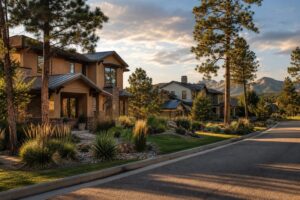
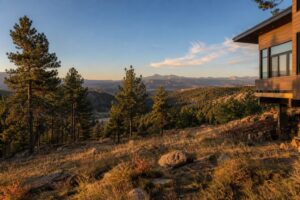
For some buyers, this structure creates exactly the quiet, controlled environment they are looking for. The entrance along Castle Pines Drive North opens into a canopy of Ponderosa pines, with winding roads, golf fairways, and red-rock formations. No strip malls, no commercial traffic. Properties in enclaves like The Pointe sit on multi-acre forested lots overlooking the Castle Pines Golf Club.
BackCountry offers a nature-focused version of privacy, with open space buffers and mountain views. However, winter trail closures and HOA trail restrictions can reduce outdoor flexibility during Colorado’s colder months. Keepers Ridge provides a quieter neighborhood feel but without the acreage or forested separation you get in the Village.
What I tell my clients is straightforward: if you are the type of person who values not seeing your neighbor’s car parked on the street and who wants predictable quiet at 9 p.m., the Village’s rules will feel like a feature. If those same rules sound restrictive, BackCountry or Keepers Ridge may be a better fit.
HOA Structure and Costs: Castle Pines Village, BackCountry, and Keepers Ridge
This is the topic that catches relocation buyers off guard most often. Having closed over 469 transactions across the South Denver Metro, I can tell you that understanding HOA and metro district costs is the single biggest learning curve for out-of-state buyers.
Castle Pines Village: Master Association Plus Sub-Associations Plus Metro District
The Castle Pines Homes Association (CPHA) was created in 1981 and operates as a non-stock, non-profit membership corporation. It is the master association for the entire Village. Here is what makes it complex:
- 19 sub-associations exist within the Village, each with its own governing documents and additional assessments
- CPHA monthly dues vary by home type, with cluster properties paying additional fees
- Dues cover staffed gate access, security patrols, emergency support, trash and recycling, pools, courts, fitness facilities, trails, playgrounds, and common-area maintenance
- Metro district mill rate is 33.834 mills, per the Village at Castle Pines Metro District. On an assessed value of $60,885, that amounts to roughly $2,060 annually through the metro district alone
- Capital improvement fee runs $89 per lot per month, per CPHA
The organization is managed by five full-time staff and over 100 volunteers across ten committees. That volunteer depth is unusual and speaks to the engagement level of Village residents.
BackCountry: HRCA Master Assessment Plus Sub-Association
BackCountry residents pay into two layers. The master Highlands Ranch Community Association (HRCA) assessment for 2026 is $696 per year, or $174 per quarter, broken into $16 for administrative functions and $158 for recreation, per HRCA. On top of that, BackCountry has its own sub-association dues for the gated community’s specific amenities and maintenance.
Keepers Ridge: Lone Tree’s Layered Structure
Keepers Ridge in Lone Tree also operates with a layered structure typical of newer Douglas County developments: a master association plus sub-association fees. Because the community is newer, special district bonds and metro district levies can add a meaningful amount to your effective property tax rate. I always recommend that buyers request the full metro district disclosure before writing an offer on any Keepers Ridge property.
Amenities and Lifestyle: What Your HOA Dollars Actually Buy in Castle Pines Village
The Village at Castle Pines spans approximately 2,800 acres with around 1,900 homes (per CPHA) to roughly 3,000 homes (per neighborhood data), and the amenity package reflects that scale:
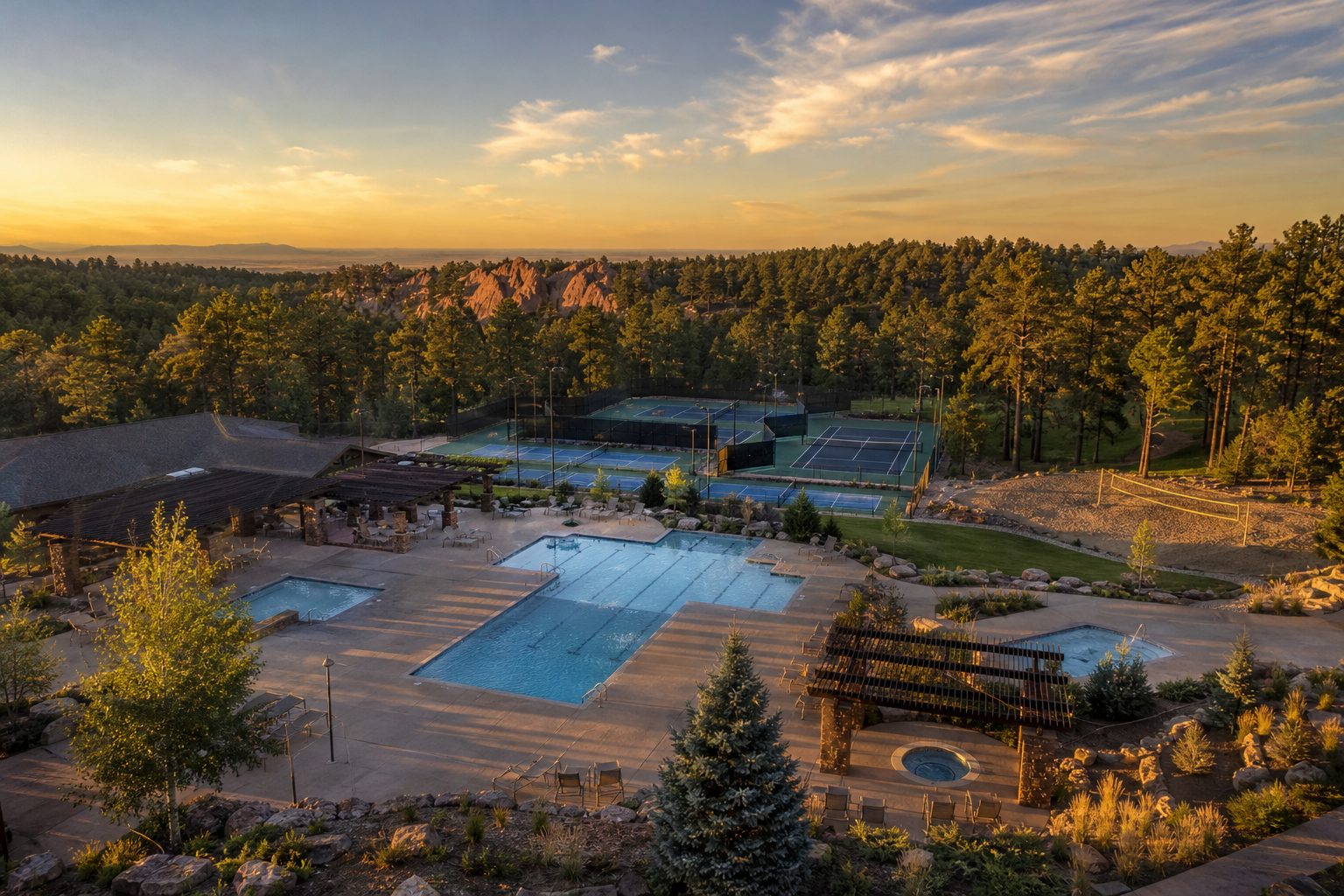
- Canyon Club: leisure pool, five tennis courts, four pickleball courts, playground, volleyball court, playing field
- Summit Club: zero-entry pool, pool slide, picnic shelter, playing field, pocket park
- Village Lake Fitness Center: cardio machines, circuit and free weights, adult lap pool, outdoor hot tub, Peloton-style bicycle room, yoga studio
- 13+ miles of scenic trails connecting community centers with views of Pikes Peak and the Front Range
- Firewise USA certification for wildfire readiness and forest stewardship
The Village also sits between two nationally recognized private golf clubs: Castle Pines Golf Club and The Country Club at Castle Pines. Golf memberships are entirely separate from HOA dues. Bear Dance Golf Club, a public-access Jack Nicklaus Signature Course, is just minutes south on Monarch Boulevard for residents who want great golf without a club membership.
BackCountry offers its own resort-style amenities within the larger Highlands Ranch framework, including access to HRCA’s 26 parks and over 70 miles of trails. Keepers Ridge benefits from Lone Tree’s public amenities and RidgeGate trail system, but its in-community amenity package is smaller.
Schools, Commute, and Long-Term Value in the Castle Pines Village Corridor
All three communities fall within Douglas County School District RE-1, but Castle Pines Village earns a public schools grade of A+ from Niche. Rock Canyon High School ranks as the number 9 best public high school in Colorado with a 4.15 out of 5 Niche rating based on 576 reviews. Buffalo Ridge Elementary and Platte River Charter Academy (rated 5 out of 5 on Niche) also serve Village families.
Commute times from Castle Pines Village are reasonable for the South Metro:
- Denver Tech Center: approximately 25 to 30 minutes via I-25
- Park Meadows and RidgeGate corridor: approximately 15 minutes
- Downtown Denver: approximately 40 to 50 minutes depending on traffic
- Colorado Springs: approximately 30 to 35 minutes south on I-25
Homes in Castle Pines Village now sell in an average of 33 days, down from 67 days a year ago, per local MLS data as of mid-2026. That acceleration signals growing buyer confidence in the luxury segment. A recent sale at 15 Castle Pines Drive closed on June 30, 2026 at $1,375,000, slightly above its $1,325,000 list price, for a 4-bedroom, 5-bath, 4,570-square-foot home. That is the kind of competitive dynamic you want to see if you are considering selling within the Village.
Frequently Asked Questions
Does Village at Castle Pines have 24/7 security at all gates?
Gate 1 is staffed 24 hours a day, 365 days a year. Gates 2 through 5 are staffed from 6:30 a.m. to 10:00 p.m., per the Castle Pines Homes Association. The community employs 40 full-time emergency services professionals who handle patrols, alarm monitoring, and access control around the clock.
How many sub-associations exist within Castle Pines Village?
There are 19 sub-associations within the Village, each with its own governing documents and additional assessments beyond the master CPHA dues, per the CPHA. Services and costs vary between sub-associations, so you should request specific disclosure documents for any neighborhood you are considering.
Are short-term rentals allowed in Castle Pines Village?
No. Rentals shorter than three months are prohibited. Rentals between three and six months require board approval. Only rentals of six months or longer can proceed without specific HOA approval, per CPHA rules.
How does BackCountry’s gate security compare to Castle Pines Village?
BackCountry operates a single gatehouse with transponder-based access, while Castle Pines Village has five staffed gates and an in-house emergency services team of 40 professionals. BackCountry residents rely on standard Douglas County and South Metro Fire Rescue for emergency response.
What is the HRCA master assessment for BackCountry residents in 2026?
The HRCA total homeowner assessment for 2026 is $696 per year, or $174 per quarter, split into $16 for administrative functions and $158 for recreation, per HRCA. BackCountry residents pay additional sub-association dues on top of this amount.
What is the metro district mill rate for Castle Pines Village?
The Village at Castle Pines Metro District has a mill rate of 33.834 mills. On an assessed value of $60,885, that equals approximately $2,060 annually through the metro district, per the district’s public records.
Can guests enter Castle Pines Village without prior approval?
No. Guests and contractors must be cleared before arrival. Event parking plans also require advance approval. This applies to all five entry gates, per CPHA community rules.
What schools serve Castle Pines Village families?
Douglas County School District RE-1 serves the Village. Rock Canyon High School is ranked number 9 among Colorado public high schools with a 4.15 out of 5 Niche rating. Buffalo Ridge Elementary and Platte River Charter Academy are also nearby options, per Niche 2026 data.
Is Keepers Ridge in Lone Tree a gated community like Castle Pines Village?
Keepers Ridge offers controlled access, but its security infrastructure is less extensive than Castle Pines Village’s five-staffed-gate system. It is a newer, smaller community with an evolving amenity and governance model typical of recent Douglas County developments.
What is the median home price in Castle Pines Village as of 2026?
The median sale price was $1.6 million over the May through August 2026 period, down 1.6% year over year. The median price per square foot is $386, up 2.4% over the same period, per local MLS data.
The Bottom Line
You are choosing between three very different interpretations of “gated community” in Douglas County. Village at Castle Pines offers the most comprehensive security, the most structured privacy rules, and the deepest amenity package, but that comes with layered costs and lifestyle regulations that are not for everyone. BackCountry gives you a nature-forward gated experience with lighter governance at a lower price point. Keepers Ridge provides a newer community feel with controlled access and proximity to Lone Tree’s commercial corridor.
The right choice depends on what you value most: maximum security and established prestige, outdoor lifestyle with moderate structure, or a newer community still defining its identity. With 130 five-star client reviews and over 30 years working in these exact neighborhoods, I am happy to walk you through the numbers side by side. Reach out to me, David, at 303-882-7706 or visit DavidRichins.com to schedule a conversation about which community fits your next chapter in the South Denver Metro.