Selling an Inherited Home in Denver South Metro: Where Do You Go From Here?
If you’ve inherited a property in the Denver South Metro and you’re wondering what to do next, here’s what you need to know about affordability, probate, and your real options in mid-2026.
[SNIPPET ANSWER: Denver South Metro inherited homes can net $500K to $750K+ depending on location and condition, but selling requires navigating Colorado probate, a shifting market, and rising ownership costs. Strategic pricing and timing are critical in 2026.]
Why Denver South Metro Affordability Matters for Inherited Property Sellers
You just inherited a home. Maybe it’s in Castle Rock, maybe Highlands Ranch, maybe a split-level in Centennial your parents bought in the 1990s. And now you’re staring at a question that feels overwhelming: what do I actually do with this?
Here’s the thing most people don’t realize right away. That inherited property is costing you money every single month you hold it. Property taxes, insurance, utilities, maintenance. In Colorado, homeowners insurance premiums have surged 137% over the past decade, with average annual costs now around $4,100. Add property taxes at Colorado’s 0.51% rate, and a $650,000 home in Centennial is quietly draining over $7,400 a year before you even touch the lawn.
The Denver South Metro market has shifted, too. With over 12,259 active listings across the metro as of May 2026 and closed sales down nearly 7% year over year, you’re no longer in the “list it and watch the offers stack up” market of 2021. But the good news? With 30 years of experience and 469 closed transactions across Douglas County and the South Metro, I can tell you that well-priced, well-presented homes are still selling, and selling well.
Understanding the Denver South Metro Market in Mid-2026
So what does the market actually look like right now, community by community? Let me break it down for you.
The overall Denver metro median sits around $585,000 to $615,000 depending on the data set, with detached homes significantly outperforming condos and attached units. But in the South Metro, your numbers shift based on exactly where that inherited property sits:
- Aurora: Approximately $510,000 median, around 35 days on market. The most buyer-friendly conditions in the South Metro right now.
- Englewood: Approximately $575,000 median, around 34 days on market, with competitive pockets near the light rail.
- Castle Rock (The Meadows): Around $630,000 median, going pending in roughly 12 days when priced correctly.
- Centennial: Approximately $650,000 median, tighter inventory, around 30 days on market.
- Castle Rock (Downtown): Median around $550,000, homes selling in as few as 6 days in many cases.
- Castle Pines: Approximately $750,000 median, about 35 days on market in this upscale community.
What does this mean for you? If your inherited property is in Founders Village in Castle Rock, you’re looking at a median around $512,500, down about 5.9% year over year. That might sound alarming, but here’s context: entry-level inventory below $550,000 across the Denver South Metro is being absorbed faster than move-up inventory. Recent national affordability data confirms that starter-home inventory in established suburban communities is the most fiercely competed-for price tier right now. First-time buyers are flooding into neighborhoods like Founders Village Castle Rock, Castlewood Ranch in Parker, and east Aurora specifically because those communities offer the sub-$550K homes that are vanishing elsewhere.
One family I worked with recently had inherited a three-bedroom ranch in Founders Village. They assumed the softening numbers meant they should wait. Instead, we listed at $505,000 with fresh paint and professional photography, and the home drew four offers in its first two weeks. The final sale price came in at $518,000 because we positioned it squarely in that affordability sweet spot where buyer demand is strongest.
Colorado Probate Requirements You Need to Navigate
Before you can sell, you need legal authority. This is where many Denver South Metro inherited-property sellers hit their first wall.
Colorado requires probate for most inherited real estate unless the property was held in joint tenancy, had a beneficiary deed (also called a transfer-on-death deed under CRS 15-15-401), or was placed in a living trust. The state’s small-estate affidavit, capped at $88,000 for 2026 deaths, only covers personal property. It cannot transfer real estate.
What the Process Looks Like

You’ll need to be appointed as Personal Representative by the court and receive Letters of Appointment before title companies will allow the transfer. Most Douglas County real estate requires a Personal Representative’s deed drafted by an attorney. Typical probate timelines run 6 to 18 months, though informal probate for uncontested estates moves considerably faster.
Key documents you’ll need include:
- Letters Testamentary or Letters of Administration from the probate court
- Death certificate (multiple certified copies recommended)
- Original will, if one exists
- Current deed and property tax records
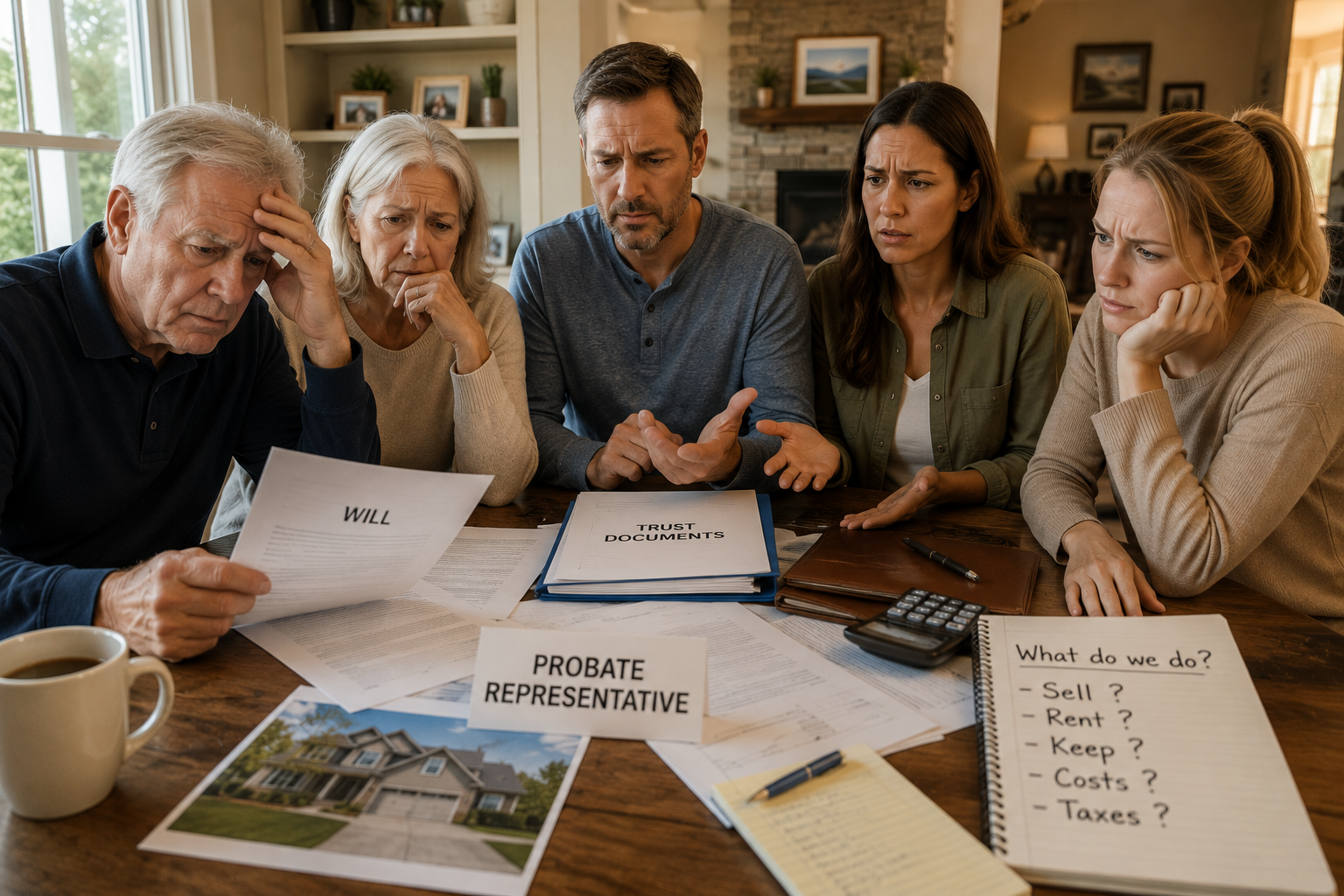
- Trust documents, if applicable
Here’s what I tell my clients who are navigating this for the first time: start the probate process immediately, even if you’re not sure whether you want to sell. You can always decide to keep the property later, but waiting to initiate probate only adds months to your timeline and increases those holding costs.
The Tax Advantage Most Denver South Metro Heirs Miss
Here’s the silver lining that catches many people off guard. Colorado has no estate tax and no inheritance tax. None. And at the federal level, you benefit from what’s called a stepped-up basis.
Your cost basis in the inherited property isn’t what your parents or grandparents paid for it. It’s the fair market value on the date of death. So if your mother purchased a home in Highlands Ranch for $185,000 in 1998 and it’s worth $650,000 today, your cost basis is $650,000, not $185,000. If you sell for $660,000, your taxable capital gain is only $10,000, not $475,000.
This is precisely why selling inherited properties relatively soon after inheriting often makes the most financial sense. The longer you hold, the more the property may appreciate beyond that stepped-up basis, and the more capital gains tax you could owe.
What does this actually look like in practice? A recent client inherited a home near Perry Street in downtown Castle Rock. The property’s date-of-death value was appraised at $545,000. We listed it after completing cosmetic updates and sold for $558,000. Their capital gain was minimal, their holding costs were kept to under four months, and they walked away with the vast majority of that equity free and clear of capital gains tax.
Selling Costs and Net Proceeds in the Denver South Metro
You need to plan for real costs. Selling inherited property in Colorado typically runs 8% to 10% in total closing costs, including agent commissions, title fees, and transfer taxes. On a $650,000 home, that’s roughly $52,000 to $65,000.
Your Holding Costs Add Up Fast
Every month you wait adds to the bill:
- Vacant-home insurance: $1,500 to $2,500 per year (and many standard policies limit coverage on vacant properties, so you’ll need to notify your insurer)
- Utilities: Gas, electric, and water continue even in an empty home. Colorado winters make heating essential to prevent pipe damage.
- Lawn care and snow removal: $100 to $250 per month depending on season
- Property taxes: Ongoing until the estate is settled
What I’ve seen repeatedly across 130 five-star client reviews is that the families who move decisively, getting the probate started, getting the property stabilized, and getting it listed within a reasonable timeline, consistently net more than those who let the process drift.
Presentation Matters More in This Denver South Metro Market
In the 2021 market, you could list a home with shag carpet and wood paneling and get 15 offers. That market is gone. Buyers in mid-2026 are placing significant emphasis on condition and long-term ownership costs. Homes with deferred maintenance are getting hit hard at the negotiating table.
For inherited properties, this is critical. Most inherited homes have some degree of deferred maintenance, whether it’s an aging roof, outdated HVAC, or simply cosmetic wear from decades of the same owner. What I tell my clients is this: you don’t need to do a full renovation. Strategic updates, fresh paint, professional cleaning, updated light fixtures, and curb appeal improvements can shift a home from “discount” pricing to “competitive” pricing.
In Castle Rock specifically, homes that are well-maintained and priced right from day one are performing well. Downtown Castle Rock listings are selling in just 6 days. Meanwhile, overpriced homes in Douglas County are sitting for 50+ days and accumulating price cuts.
The difference between a $580,000 sale and a $540,000 sale in The Meadows often comes down to presentation and pricing strategy, not the market itself.
Where Denver South Metro Buyers Are Actually Looking
If you’re wondering who’s going to buy your inherited property, the answer depends on where it sits. The July 2026 starter-home affordability data paints a clear picture: first-time buyers are being squeezed out of Denver proper and pushed south along the I-25 corridor. They’re landing in communities where they can still find a three-bedroom home under $550,000.
That means demand is strongest in:
- Founders Village (Castle Rock): Sub-$550K three-bedroom homes with established schools and trail access
- Aurora: The most affordable entry point in the South Metro at around $510,000 median
- Englewood: Competitive pockets with light rail access attracting young professionals
Move-up buyers, meanwhile, are targeting Castle Pines Village, Highlands Ranch’s Backcountry, and Lone Tree’s RidgeGate, where homes in the $700K to $900K range offer larger lots and newer finishes.
This means your inherited property’s buyer pool is directly tied to its price point. A Douglas County real estate agent who understands these micro-market dynamics can position your listing to attract the right buyers at the right price.
Frequently Asked Questions
Do I need to go through probate to sell an inherited home in Castle Rock?
Most likely, yes. Colorado requires probate for real estate held solely in the deceased person’s name. Exceptions include properties in a living trust, joint tenancy, or with a beneficiary deed. The state’s small-estate affidavit does not cover real estate regardless of value.
How long does Colorado probate take for Denver South Metro properties?
Informal probate for uncontested estates typically takes 6 to 12 months. Formal probate with disputes or complex assets can extend to 18 months or longer. Starting the process immediately helps minimize your holding costs on the inherited property.
Will I owe capital gains tax on an inherited home in Highlands Ranch?
Colorado has no estate or inheritance tax. Federally, you receive a stepped-up cost basis equal to the property’s fair market value on the date of death. If you sell soon after inheriting, your capital gains exposure is typically minimal.
What are the total costs to sell an inherited home in Douglas County?
Expect total selling costs of 8% to 10% of the sale price, including agent commissions, title fees, and closing costs. On a $650,000 home, that translates to roughly $52,000 to $65,000 in total expenses.
Can I sell the inherited property before probate is complete?
You cannot transfer the deed until the court appoints a Personal Representative and issues Letters of Appointment. However, you can begin preparing the home for sale, getting inspections, and consulting with a Denver South Metro realtor while the probate process moves forward.
Should I renovate an inherited home before selling in Castle Rock?
Full renovations are rarely necessary. Strategic cosmetic updates like fresh paint, professional cleaning, updated fixtures, and curb appeal improvements deliver the strongest return. In this market, presentation and pricing strategy matter more than expensive remodels.
How does insurance work on a vacant inherited property?
Standard homeowners policies often limit coverage on vacant homes. You should notify your insurer immediately and may need a vacant-property rider or separate policy, typically costing $1,500 to $2,500 per year.
What if multiple heirs disagree about selling in Denver South Metro?
Disputes among co-heirs are common and can delay the sale significantly. A Colorado relocation specialist or experienced real estate agent can help facilitate conversations, but legal mediation may be necessary if heirs cannot reach agreement.
Can out-of-state heirs sell Colorado real estate?
Yes, but out-of-state heirs typically need either a Colorado ancillary probate proceeding or recognition of a Personal Representative appointed in another state under CRS 15-13-204. Remote closings are common and can often be handled with power of attorney.
What’s the best time of year to sell an inherited home in the Denver South Metro?
Spring and early summer typically see the most buyer activity across Castle Rock, Parker, Centennial, and Highlands Ranch. However, well-priced homes sell year-round. The key factor is completing probate and preparing the property, not waiting for a specific season.
The Bottom Line
Inheriting a property in the Denver South Metro can feel overwhelming, especially when you’re navigating grief, legal processes, and a market that’s more nuanced than it’s been in years. But the fundamentals are in your favor: Colorado’s stepped-up basis protects you from major capital gains exposure, demand for well-priced homes remains strong across Castle Rock, Highlands Ranch, Parker, and beyond, and buyers are actively searching for exactly the type of established homes that make up most inherited properties.
The most important thing you can do right now is stop waiting and start planning. Every month of inaction adds holding costs and uncertainty. If you’ve inherited a home anywhere in the Denver South Metro and you’re asking “where do I go from here,” I’d welcome the conversation. With 30 years of experience and 469 closed transactions across this market, I’ve helped families in exactly your situation find clarity. Call me, David Richins, at 303-882-7706 or visit DavidRichins.com. Let’s figure out your best path forward together.