What do you need to know before buying luxury equestrian property in Franktown or Larkspur, Colorado?
Buying 10 acres in Franktown is not just buying real estate. You are buying water rights, well permits, and zoning permissions. Miss one line item, and your $2.5M dream estate becomes an unbuildable liability.
Why Franktown and Larkspur Equestrian Real Estate Demands Your Attention Right Now
The Denver South Metro market is recalibrating. Median home prices across the metro sit around $614,000 to $615,000, up roughly 2.5% year over year. But here is the thing: Franktown is an entirely different animal. The median home price in Franktown currently sits around $1,137,000, with listed homes reaching a median of $1.64M. Some properties stretch well beyond $4.2M. This is not a suburban market. This is legacy acreage buying territory.
So why now? With 30 years of experience serving the Denver South Metro corridor and over 469 closed transactions, what I can tell you is that this moment is unusual. Inventory has climbed significantly across the broader Denver market, giving buyers more choices. But equestrian-ready acreage in Franktown and Larkspur is still remarkably limited in supply. The properties that combine the right water rights, the right zoning, and the right improvements remain fiercely competitive.
If you are a high-net-worth relocation buyer searching for 5 to 35 or more acres with a custom home, outbuildings, and mountain views, this is the guide you need before you write an offer.
Understanding Franktown: Why It Is Colorado’s Premier Equestrian Address
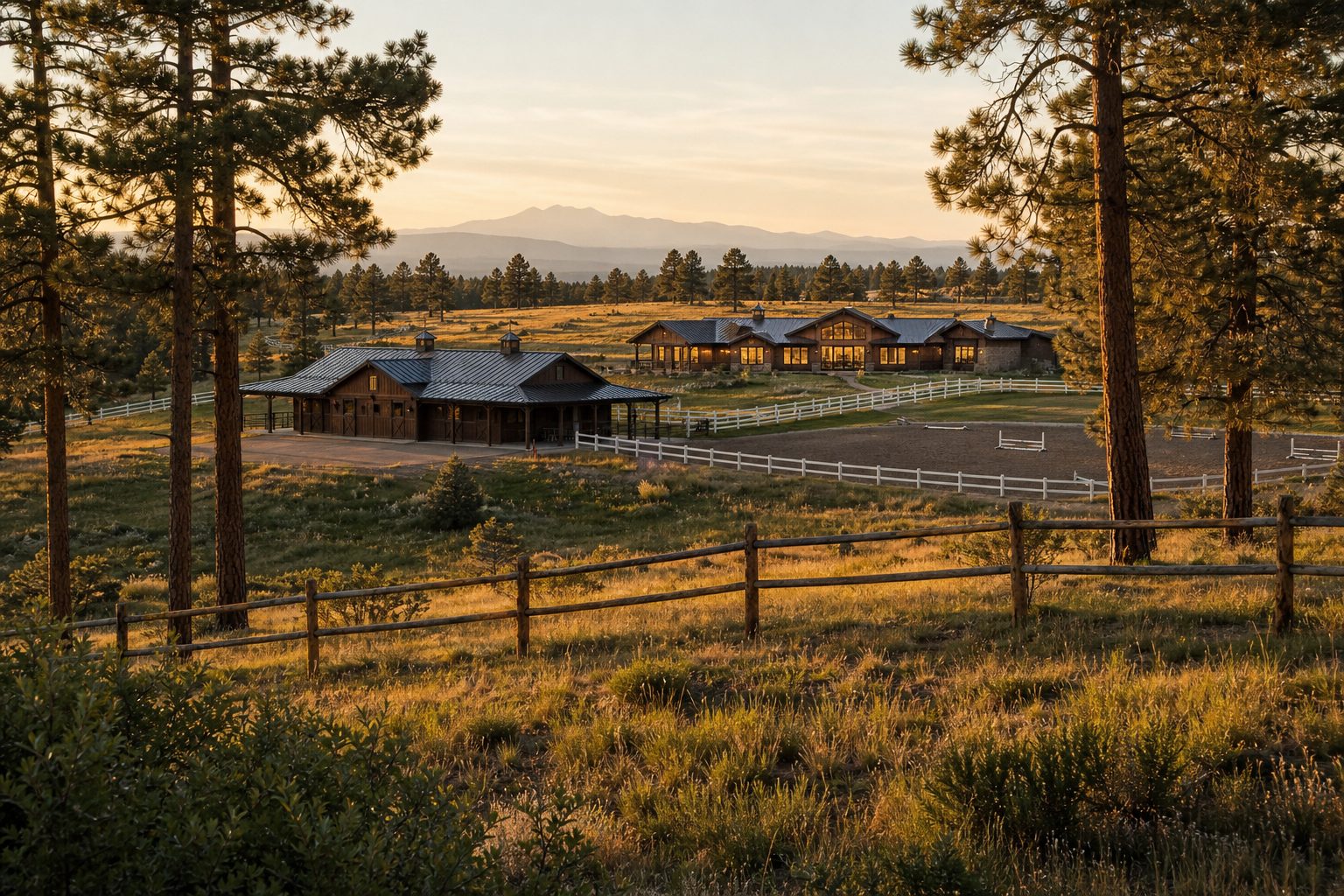
Drive south on State Highway 83 past the junction with Franktown Road and the world changes immediately. Ponderosa pine canopies replace streetlights. Split-rail fences line 20-acre parcels. You pass handmade ranch signage and the occasional horse trailer parked beside a custom timber-frame home. There are no strip malls, no chain restaurants, no apartment complexes.
What you find instead are rolling meadows, red-rock outcroppings, and views from Pikes Peak to Longs Peak on a clear morning.
Franktown’s geology is a horse owner’s dream. The sandy loam soil drains exceptionally well, meaning less mud in spring and better footing year-round. The rolling hills provide natural drainage that prevents the mud-related hoof issues common in flatter, low-lying regions. Additionally, the thick Ponderosa Pine canopy creates a microclimate that benefits livestock all year, acting as natural windbreaks against harsh winter gusts while offering essential shade during 90-degree summer days.
Key Neighborhoods and Price Ranges in Franktown
- Arrowpoint Estates offers privacy and open space, with lots starting at $1.98M. A recent listing at 1721 Arrowpoint Court, a 4-bedroom, 4.5-bathroom ranch on 2 acres, was listed at $1.86M.
- Bannockburn and Burning Tree Ranch feature custom homes on generous acreage.
- The Meadows at Castlewood, a gated community bordering Castlewood Canyon State Park, commands premium pricing for its trail connectivity.
- Russellville Road is home to premier large-lot ranches, including 35+ acre parcels.
Home values across Franktown range from roughly $280,000 to over $4.2M, reflecting an enormous spread driven entirely by acreage and improvements. Approximately 86% of Franktown homes are owner-occupied, which tells you something important about the community: people invest here for the long term.
Despite the rural feel, you are only 10 to 15 minutes from the shopping and dining of Parker or Castle Rock. That “privacy without isolation” balance is exactly what draws buyers from across the country.
Water Rights and Well Permits: The Deal-Maker or Deal-Breaker in Franktown
Here is where I spend the most time educating my clients, and after 130 five-star reviews and three decades in Douglas County real estate, I can tell you that water is the single most misunderstood aspect of buying acreage in Franktown.
Franktown sits above the Denver Basin Aquifer System, a series of four layered non-tributary aquifers:
- Dawson Aquifer is the shallowest and fastest to drill but delivers the lowest yield. Typically used for household-only permits.
- Denver Aquifer offers mid-depth access and moderate yield. Commonly permitted for residential use.
- Arapahoe Aquifer goes deeper, delivers higher yield, and is more reliable for livestock and irrigation needs.
- Laramie-Fox Hills Aquifer is the deepest and most reliable, and it is critical for high-volume equestrian operations.
The Two Well Permit Types That Make or Break Your Purchase
Household-Only Well Permit (HEU): This covers indoor household use and up to 1 acre of lawn and garden irrigation. If you are planning a horse barn with 10 stalls, this permit does not cover livestock watering. One couple relocating from Texas came to me ready to close on a gorgeous 15-acre parcel near Castlewood Canyon. During our due diligence, we discovered the property only carried a household-only well permit. The cost and timeline to secure a livestock-class permit would have delayed their equestrian operation by more than a year. We pivoted to a property on Russellville Road that already had a commercial well permit in place, and they were riding their own trails within 90 days of closing.
Commercial/Livestock/Equestrian Well Permit: This is required for properties operating with horses, cattle, or commercial agriculture. These permits require Colorado Division of Water Resources approval and must align with the applicable aquifer allocation. Some Franktown parcels already carry these permits, which represents a significant and independently verifiable value-add.
What I tell my clients is simple: always pull the Colorado Division of Water Resources well permit records before submitting an offer. Confirm which aquifer the permit draws from, the permitted use class, and the gallons-per-minute yield on the well log.
Zoning, Outbuildings, and Arena Restrictions in Douglas County
This is where out-of-state buyers get burned most frequently. Franktown parcels fall primarily under two Douglas County zoning designations, and the difference between them can determine whether your equestrian vision is achievable or not.
A-1 Agricultural Zoning (35+ Acre Parcels)
This is the zoning tier most high-net-worth acreage buyers are targeting. A-1 allows horses, livestock, barns, riding arenas, and accessory structures with relatively generous setback allowances. Barn and arena setbacks in A-1 typically require 50 feet from property lines and 100 feet from public roads, but you must verify with Douglas County Planning at the individual parcel level.
Large-Lot Residential (5 to 35 Acres)
This designation is more restrictive on outbuildings. HOA covenants layered on top of county zoning can further prohibit commercial equestrian operations, arena lighting, and certain barn sizes:
- Hidden Pointe imposes strict architectural review and limits outbuilding height and materials.
- Foxfield (to the north) allows horses by right but restricts commercial boarding entirely.
Douglas County zoning laws also strictly regulate arena lighting and size. It is vital to confirm that any existing arena or round pen is permitted for its current use. Professional-grade arenas that are already permitted and installed can command a 20% premium over comparable properties without them.
If your plan involves a 10-stall barn, a lit outdoor arena, and a guest trainer apartment, you need A-1 zoning or an approved special use permit. Period.
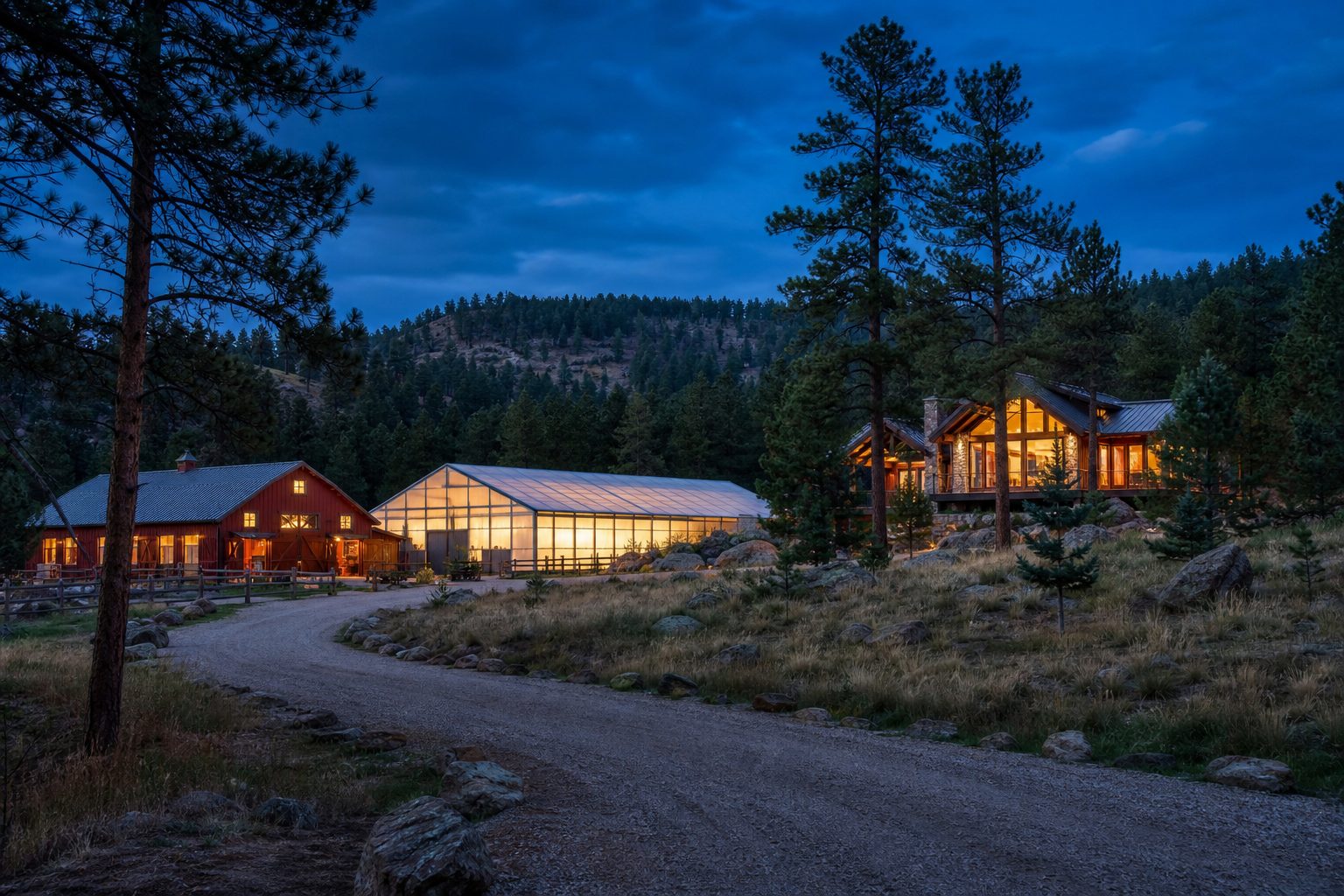
Larkspur Luxury Equestrian Homes: Fire Mitigation, Insurance, and the Full Picture
Larkspur sits south along the I-25 corridor, offering its own distinct appeal for equestrian buyers. The terrain here trends toward heavier timber and steeper terrain compared to Franktown’s rolling meadows. That Ponderosa and Douglas fir coverage is visually stunning, but it introduces a consideration that many relocation buyers do not anticipate: wildfire mitigation and property insurance.
On multi-million dollar timber-heavy lots in Larkspur, your wildfire mitigation rating directly impacts your ability to secure affordable property insurance. What I recommend to every buyer considering Larkspur acreage is a pre-offer wildfire assessment. You want to know the defensible space status, the access road width for emergency vehicles, and the property’s current Community Wildfire Protection Plan rating before you negotiate price.
A recent buyer I worked with fell in love with a Larkspur property featuring a 6-stall barn, covered arena, and panoramic mountain views. The property was beautiful, but the previous owner had not maintained defensible space. Insurance quotes came back $8,000 higher annually than expected. We negotiated a seller credit for professional fire mitigation work, brought the property into compliance, and the buyer’s insurance normalized. That single negotiation saved tens of thousands over the life of ownership.
Trail Access, Lifestyle, and the Franktown and Larkspur Equestrian Community
Cherry Creek Regional Trail parallels Cherry Creek and connects broader parts of the region, passing through Parker, Centennial, and Franktown. Horseback riding is permitted on the Cherry Creek Regional Trail, though not across the full trail system at Castlewood Canyon State Park. You will want to understand exactly where horse use is allowed if public riding is part of your routine.
Several Franktown estates border or carry private easements into Castlewood Canyon State Park, and that trail connectivity directly drives property values. The Franktown Cafe, located at the corner of Highway 83 and Highway 86, is the community gathering point where ranchers, horse trainers, and weekend equestrians have connected for decades. Schools in the Douglas County RE-1 district consistently earn GreatSchools ratings of 8 to 9 out of 10, with Chaparral High School rated 8 out of 10 for AP programming and athletics.
Frequently Asked Questions About Franktown and Larkspur Equestrian Real Estate
What is the median home price in Franktown, Colorado?
The median home price in Franktown is approximately $1,137,000 to $1,140,500, significantly higher than the overall Douglas County median of about $614,790. Listed prices for equestrian properties often reach $1.64M and beyond, depending on acreage, improvements, and water rights.
Do I need a special well permit for horses on Franktown acreage?
Yes. A standard Household-Only Well Permit does not cover livestock watering. You need a Commercial or Livestock Well Permit approved by the Colorado Division of Water Resources if you plan to keep horses on the property.
What aquifer does Franktown draw water from?
Franktown sits above the Denver Basin Aquifer System, which includes four layers: Dawson, Denver, Arapahoe, and Laramie-Fox Hills. Equestrian operations typically require access to the deeper Arapahoe or Laramie-Fox Hills aquifers for adequate yield.
What zoning do I need for an equestrian facility in Douglas County?
A-1 Agricultural zoning on 35+ acres provides the most flexibility for barns, arenas, and livestock operations. Large-Lot Residential parcels of 5 to 35 acres are more restrictive, especially when HOA covenants are layered on top.
How does wildfire risk affect Larkspur equestrian property insurance?
Timber-heavy Larkspur lots require active wildfire mitigation to secure affordable insurance. Properties without maintained defensible space can see insurance premiums increase by thousands of dollars annually.
Can I ride horses on trails near Franktown properties?
Horseback riding is permitted on the Cherry Creek Regional Trail. Some Franktown estates offer private trail easements into Castlewood Canyon State Park, though horse use is restricted on portions of the park’s trail system.
How many horses can I keep on my Franktown parcel?
Douglas County animal guidance allows one boarded horse on 2.3 to 4.49 acres, two horses on 4.5 to 8.9 acres, and more flexible thresholds on 9+ acre parcels depending on zone district and review type.
Are arena lighting and barn sizes regulated in Douglas County?
Yes. Douglas County zoning laws strictly regulate arena lighting and size. You must confirm that any existing arena is permitted for its current use. Professional-grade permitted arenas command approximately a 20% premium at sale.
What are conservation easements, and do they affect Franktown property values?
Some Franktown parcels carry conservation easements that permanently restrict development on portions of the land. These can enhance privacy and views while limiting future subdivision or building potential. They must be thoroughly reviewed before purchase.
How long does it take to sell luxury equestrian property in this market?
Across the Denver metro, well-priced homes sell within 19 to 30 days. Specialty equestrian properties attract a narrower but highly motivated buyer pool. Proper pricing and marketing to equestrian-specific channels is critical for a timely sale.
The Bottom Line on Buying Equestrian Acreage in Franktown and Larkspur
You are not just buying a home when you purchase equestrian acreage in Franktown or Larkspur. You are buying water rights, well permits, zoning entitlements, and a lifestyle that demands specialized due diligence at every step. The sandy loam soil, the Ponderosa pine canopies, the trail connectivity, and the mountain views are extraordinary. But none of that matters if the water permit does not support your operation or the zoning blocks your barn.
With 30 years specializing in luxury and equestrian real estate across Douglas County and over 469 closed transactions, I have guided buyers through every version of this process. If you are considering Franktown or Larkspur equestrian property, I would welcome the chance to walk you through the details that listing brochures leave out. Call me, David Richins, at 303-882-7706 or visit my community pages on DavidRichins.com to explore current listings across Franktown, Larkspur, Castle Rock, and the entire Denver South Metro corridor.