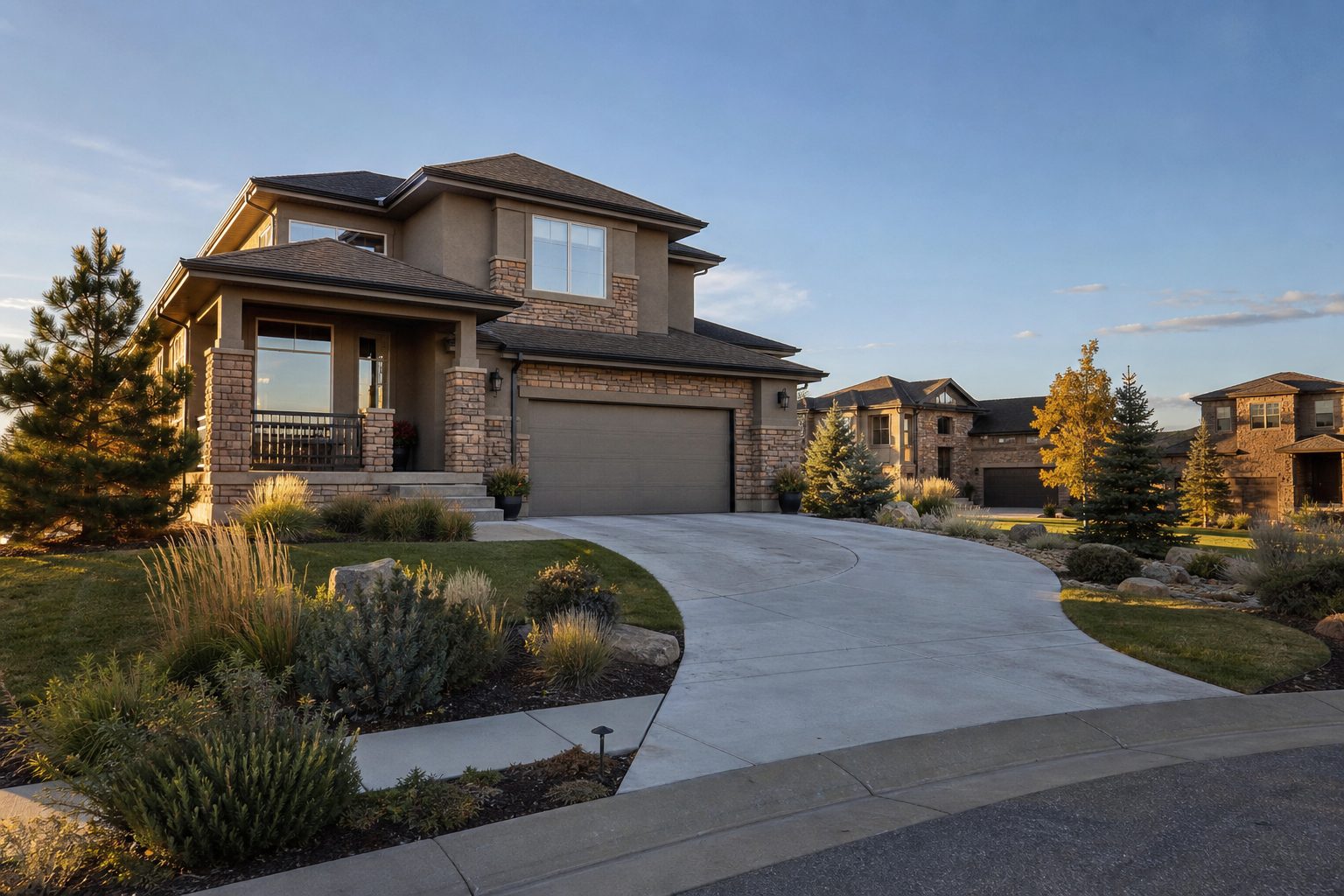
How do property taxes and metro district mill levies compare across South Metro Denver communities like Castle Rock, Highlands Ranch, Parker, and Lone Tree?
Property taxes in South Metro Denver vary dramatically depending on whether your home sits inside a metro district. Two homes at the same price point can produce annual tax bills that differ by $1,500 to $2,000 or more, and the metro district mill levy is almost always the reason.
Why This Matters Right Now in South Metro Denver
If you’re relocating to Colorado from another state, the property tax structure here is probably unlike anything you’ve encountered before. Colorado uses a split assessment rate system for the 2026 tax year, and on top of that, many newer South Metro Denver communities carry additional metro district mill levies that can add 30 to 50 mills to your tax bill.
Here is why this matters in 2026 specifically. South Metro Fire Rescue passed a new three-mill levy in November 2025, adding roughly $50 million in annual revenue across Highlands Ranch, Lone Tree, Castle Pines, and parts of Centennial and Parker, per CPR News reporting. That means your tax bill in these communities has already increased compared to what previous owners paid. With 30 years of experience helping buyers navigate the South Metro market and over 469 closed transactions, I can tell you that understanding your total property tax obligations before you make an offer is not optional. It is essential.
How Colorado’s 2026 Split Assessment Rate Works in Douglas County
You need to understand this foundation before anything else. Colorado does not apply a single assessment rate to your home. For property tax year 2026, the Colorado Division of Property Taxation applies two separate rates to the same property.
- Local government assessment rate: 6.8%, applied after first reducing the property’s actual value by 10%, capped at a maximum reduction of $70,000
- School district assessment rate: 7.05%, applied directly to the full actual value with no reduction
What does that actually mean for your monthly budget? It means calculating your expected taxes is not as simple as multiplying one rate by your home’s value. The school portion of your bill (which is typically the largest single piece) hits harder because it does not benefit from that 10% reduction.
So when you are comparing two South Metro Denver homes, even in the same school district, the total mill levy is what separates a manageable tax bill from one that takes your breath away.
What Metro Districts Are and Why They Exist in South Metro Denver
A metropolitan district is a quasi-governmental entity formed under Title 32 of the Colorado Revised Statutes. According to the Colorado Association of Homebuilders, a developer forms the district, the district issues bonds to pay for infrastructure like roads, water systems, parks, and drainage, and the homeowners who move in later repay those bonds through a debt service mill levy on their property taxes.
Why would anyone agree to that? Because metro district financing actually reduces the upfront cost of your home. If those infrastructure costs were built into the purchase price, many homes in master-planned South Metro communities would be priced tens of thousands of dollars higher. Instead, you pay it back gradually through your tax bill over a repayment period that can stretch up to 40 years.
Where Metro Districts Are Most Common
In my experience, nearly every newer development in Castle Rock, the newer sections of Parker, and communities built in Castle Pines within the last 15 years carry some form of metro district mill levy. If the neighborhood was platted after 2000, has its own parks and a monument sign at the entrance, you should assume a metro district exists until the records prove otherwise. Since January 1, 2024, Colorado sellers inside a metro district organized on or after January 1, 2000 must provide the buyer with the district’s official website, per state disclosure law.
The Real Dollar Difference: Established vs. Metro District Communities
This is where relocation buyers need to pay the closest attention. Let me walk you through what the numbers actually look like.
Established South Metro neighborhood (no metro district):
- Base mill levy: approximately 80 to 85 mills
- Metro district debt mills: 0
- Total effective mills: approximately 80 to 85
- Annual tax on a $600,000 home: roughly $3,200 to $3,500
- Monthly impact: roughly $267 to $292
Newer South Metro community (with metro district):
- Base mill levy: approximately 80 to 85 mills
- Metro district debt mills: 30 to 50 additional mills
- Total effective mills: approximately 110 to 135
- Annual tax on a $600,000 home: roughly $4,500 to $5,500 or more
- Monthly impact: roughly $375 to $458 or more
That is a potential difference of over $100 per month on the exact same priced home. Over 10 years of ownership, you are looking at $13,000 to $24,000 in additional taxes.
What I tell my clients is this: neither option is inherently better or worse. The metro district community often gives you newer infrastructure, better amenities, and a lower purchase price. But you need to budget accurately, and that means knowing the full mill levy before you write your offer.
A Douglas County Mill Levy Breakdown for Comparison
To give you a concrete baseline, a representative Douglas County tax district (District 0035) carries a total mill levy of 81.640 mills, per the Douglas County Assessor’s published tax district data. Here is how that breaks down:
- Douglas County Government: 18.524 mills
- Douglas County Law Enforcement: 4.500 mills
- Douglas County Re-1 School District: 35.743 mills
- Douglas County Schools Debt Service: 8.054 mills
- South Metro Fire Rescue: 9.319 mills (before the additional 3-mill levy)
- Douglas Public Library District: 4.021 mills
- Urban Drainage and Flood Control: 0.900 mills
- Cherry Creek Basin Water Quality Authority: 0.479 mills
- Urban Drainage South Platte: 0.100 mills
That 81.640-mill base is what you see in an established Douglas County neighborhood without a metro district overlay. Now imagine adding 40 or 50 mills on top. You can see how quickly the math changes.
Having helped over 469 families through these decisions and earned 130 five-star reviews, I always make sure my relocation clients pull the actual mill levy certificate for any property they are seriously considering. The Denver metro market conditions and local tax structures demand this level of detail.
South Metro Fire Rescue: The 2025 Levy Change You Need to Know About
This is a detail many relocation buyers miss. South Metro Fire Rescue’s Ballot Issue 7A passed in November 2025 with 55.6% of the vote, per CPR News. The measure adds three mills to the district’s property tax rate, generating roughly $50 million annually to cover a projected budget shortfall caused by the passage of House Bill 24B-1001.
If your home is in Highlands Ranch, Lone Tree, Castle Pines, or parts of Centennial and Parker, this additional levy is already reflected in your 2026 tax bill. It is not enormous on its own, but layered on top of a metro district levy, it is one more factor pushing your total mills higher.
Tax Relief Programs That Can Help in South Metro Denver
Colorado does offer meaningful property tax relief for qualifying homeowners.
- Senior Homestead Exemption: 50% of the first $200,000 of actual value is exempt from property tax, which is up to $100,000 excluded from the tax calculation. Full funding is in place for 2026, per the Colorado Division of Property Taxation.
- Property Value Appeals: You have until June 1 to contest your valuation after receiving your Notice of Value in May. Do not miss this deadline.
- Important Warning: Exemptions do not transfer when a property sells. Never budget based on the seller’s tax bill, because their senior or veteran exemption disappears at closing.
Frequently Asked Questions
What is a metro district mill levy in Colorado?
A metro district mill levy is an additional property tax assessed on homes within a metropolitan district, a quasi-governmental entity formed under Title 32 of the Colorado Revised Statutes. Developers form these districts to finance infrastructure like roads, water, and parks. Homeowners repay the bonds through this extra levy, which commonly adds 30 to 50 mills on top of standard county and school taxes.
How do property taxes compare across Douglas County communities?
Property taxes in Douglas County vary significantly based on whether a community has a metro district. Established neighborhoods typically carry total mill levies around 80 to 85 mills, while newer developments with metro districts can see total levies of 110 to 135 mills, per Douglas County Assessor data. On a $600,000 home, that translates to a difference of roughly $1,300 to $2,000 per year.
Why are property taxes higher in newer South Metro Denver neighborhoods?
Newer neighborhoods are more likely to sit inside a metro district. The district issues bonds to pay for infrastructure, and homeowners repay those bonds through a debt service mill levy. Service plans commonly cap this levy at 50 mills with a repayment term of up to 40 years, per the Colorado Association of Homebuilders.
What is Colorado’s residential assessment rate for 2026?
For tax year 2026, Colorado applies a local government assessment rate of 6.8% after reducing the property’s actual value by 10% (capped at $70,000). School districts use a separate rate of 7.05% applied to the property’s full actual value with no reduction, per the Colorado Division of Property Taxation.
How does the South Metro Fire Rescue mill levy increase affect my taxes?
South Metro Fire Rescue’s Ballot Issue 7A, passed in November 2025, adds three mills to the property tax rate for homes in Highlands Ranch, Lone Tree, Castle Pines, and parts of Centennial and Parker, generating roughly $50 million annually per CPR News.
Do I have to be told about a metro district before buying in South Metro Denver?
Yes. Since January 1, 2024, Colorado sellers inside a metro district organized on or after January 1, 2000 must provide the buyer with the district’s official website. However, always conduct your own due diligence and pull the actual mill levy certificate for any property you are considering.
How do I calculate my expected property taxes in Castle Rock or Parker?
Use this formula from the Colorado Division of Property Taxation: Actual Value multiplied by Assessment Rate equals Assessed Value. Then Assessed Value multiplied by (Total Mill Levy divided by 1,000) equals Annual Property Tax. One mill equals $1 per $1,000 of assessed value. Total mill levies in Colorado typically range from 60 to 120 mills.
Can I appeal my property tax valuation in Douglas County?
Yes. After receiving your Notice of Value in May, you have until June 1 to file an appeal. This deadline is strict and missing it means you accept the assessed value for that cycle. The next reassessment occurs in 2027.
What is the senior homestead exemption in Colorado for 2026?
Colorado’s constitutional senior homestead exemption excludes 50% of the first $200,000 of actual value from property tax, up to $100,000 of actual value removed from the calculation. Full funding is confirmed for 2026, per the Colorado Division of Property Taxation. This exemption does not transfer to a new buyer when the property sells.
How much higher are metro district taxes compared to Denver city taxes?
Denver’s combined baseline mill levy sits at 79.602 mills, per Denver’s assessment data, producing an effective rate between 0.48% and 0.55% of market value. A South Metro home in a metro district could face 110 to 135 mills total, creating a meaningfully higher effective rate, though South Metro home prices and amenities often differ from Denver proper.
The Bottom Line
Understanding all costs involved in buying a home, especially property taxes and mill levies, is not one-size-fits-all in South Metro Denver. The metro district mill levy is the single biggest variable that separates a comfortable monthly payment from an unexpected stretch. As a top-rated Colorado Realtor with 30 years of experience, 469 closed transactions, and 130 five-star reviews, I help relocation buyers understand the full picture before they make one of the biggest financial decisions of their lives. If you are moving to Castle Rock, Parker, Highlands Ranch, Lone Tree, Castle Pines, or anywhere else in the South Metro area and want to know exactly what your tax bill will look like before you commit, call me at 303-882-7706 or visit DavidRichins.com. Getting the mill levy right is not a detail. It is the decision.