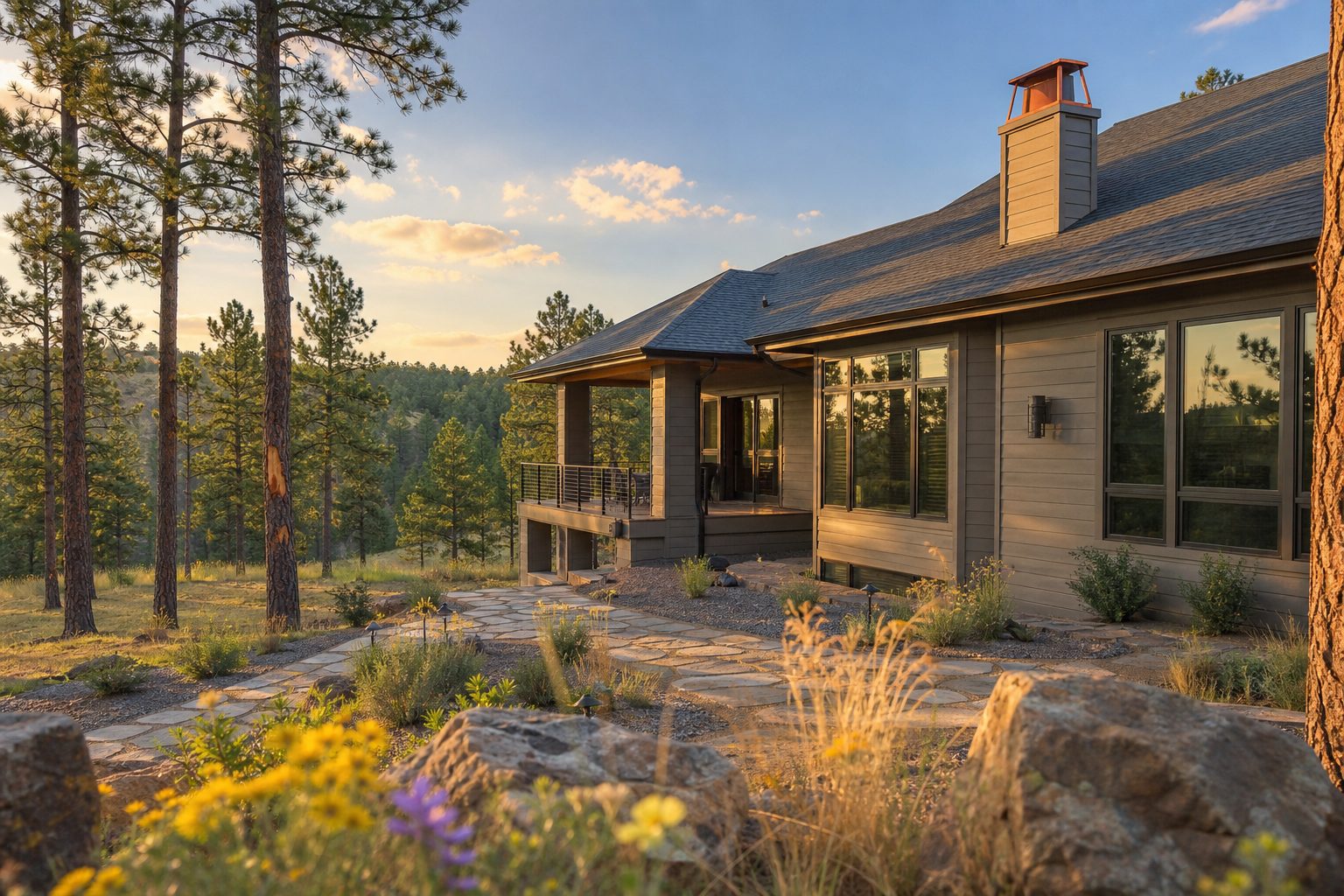
What are the precise insurance implications and mitigation requirements for homes above $1.2M located in Wildfire Urban Interface (WUI) zones like Castle Rock, Franktown, or Larkspur?
If you own or are buying a home above $1.2M in the WUI zones of Castle Rock, Franktown, or Larkspur, you face potential non-renewals, premiums exceeding 200% of standard rates, a current FAIR Plan coverage cap that may leave you underinsured, and mandatory defensible space and fire-hardening requirements under Colorado’s new Wildfire Resiliency Code.
Why Wildfire Insurance in Castle Rock, Franktown, and Larkspur Matters Right Now
Colorado’s new statewide Wildfire Resiliency Code reached full enforcement on July 1, 2026, according to the Colorado Division of Insurance, making Colorado the first Western state after California to adopt mandatory fire-hardening standards for homes in WUI areas. If you own a luxury property surrounded by the ponderosa pine forests of Douglas or Elbert County, this directly affects your ability to insure, sell, or buy.
Here is what makes this moment especially urgent for high-value properties: approximately 750,000 homes sit in WUI areas across Colorado, per the Colorado Division of Insurance. Castle Rock, Franktown, and Larkspur each contain significant WUI-designated zones because of their proximity to forests, scrub oak, and grassland interfaces along the Front Range foothills. With a median listing price of $775,000 in Douglas County as of April 2026 (per FRED/Federal Reserve Bank of St. Louis data), many properties along this corridor well exceed the $1.2M threshold, and they are the ones facing the steepest insurance challenges.
With 30 years of experience and 469 closed transactions in this market, I have watched this insurance landscape shift dramatically. So let me walk you through exactly what you need to know.
The Colorado Wildfire Resiliency Code and What It Requires in Castle Rock WUI Zones
The Colorado Wildfire Resiliency Code (CWRC) was adopted by the state’s Wildfire Resiliency Code Board on July 1, 2025, based on the 2024 International Wildland-Urban Interface Code. Local jurisdictions were required to adopt it by April 1, 2026, and full enforcement began on July 1, 2026, per Fire Ready Colorado.
What the CWRC Mandates
The code splits WUI zones into fire intensity classifications, and material requirements scale with risk. According to Colorado Planning for Hazards, the requirements typically include:
- Roof assembly and covering: Class A roof coverings are required in all WUI classifications
- Vents and eaves: Ember-resistant or flame-resistant vent screens are mandatory
- Exterior walls and windows: Non-combustible building materials, with requirements increasing in higher-intensity zones
- Gutters: Noncombustible gutters required even in low fire intensity zones
- Vegetation management: Tree thinning, spacing, limbing, and trimming, plus removal of ladder fuels growing under tree canopies
Does This Apply to Your Existing Home?
Here is the critical distinction. The CWRC is not retroactive. Per the code’s own Section 102.8, a home standing legally before adoption continues as-is. However, the code is triggered when repairs exceed 25% of the structure (for example, replacing a hail-damaged roof) or when you undertake a major renovation or addition over 500 square feet. According to state and homebuilder estimates, compliance adds roughly 2.7% to 20% to construction costs, per the Colorado Division of Insurance. On a $1.2M home, you are potentially looking at significant additional expense for qualifying renovations.
What does this mean in practical terms for the neighborhoods east of I-25 toward Franktown, or up in the pine-covered lots around Larkspur? If you are planning a major remodel before listing, your project just got more complex and more expensive.
Insurance Challenges Specific to High-Value WUI Homes in Douglas County
Properties above $1.2M in this corridor face what I can only describe as unprecedented insurance challenges: non-renewals, premium increases exceeding 200%, and in some cases, complete inability to obtain coverage in the standard market. Insurers are increasingly evaluating wildfire risk and may require fire-resistant siding, tempered windows, and ignition-resistant exterior materials before binding a policy, according to the Colorado Division of Insurance.
The FAIR Plan Coverage Gap
Colorado’s FAIR Plan, created by HB23-1288, serves as the safety net for homeowners who cannot find coverage in the standard market. But here is the problem for luxury homeowners: the current FAIR Plan dwelling coverage cap is $750,000. If you own a $1.4M home in Larkspur, that leaves a $650,000 gap. A 2026 legislative proposal would expand the FAIR Plan’s capacity from $750,000 to $1.5 million in dwelling coverage and create a state reinsurance program, per the Colorado Division of Insurance. You should track this legislation closely because it could change your coverage options significantly.
The Two-Map Problem You Need to Understand
The state has been explicit: the CWRC’s WUI map and the maps insurers use are completely separate tools. The Colorado Division of Insurance confirmed that the map created by the Wildfire Resiliency Code Board is for the application of the code only and is not intended for insurance purposes. Insurers use their own tools, methodologies, and proprietary risk models to assess wildfire risk and determine pricing. The state has also confirmed that insurers cannot use the code’s WUI/fire-intensity map to justify raising your rate.
So what does your insurer actually use? Their own models. And thanks to HB 25-1182, which took effect July 1, 2026, insurers must now provide a written wildfire risk score within 15 days of an application or renewal request if you ask. No more “black box” pricing.
Defensible Space and Mitigation Requirements for Castle Rock, Franktown, and Larkspur Properties
This is where your investment in mitigation can directly influence your insurability and premium costs. In the pine-forested areas of Douglas and Elbert counties, insurers require strict defensible space compliance with 30 to 100 foot clear zones, Class A fire-rated roofing, spark arrestors, and ember-resistant vent screens before binding high-value home insurance policies. If you are shopping for a luxury home along the Franktown corridor or up in the wooded lots around Larkspur, these are not suggestions. They are prerequisites for getting insured.
Your Mitigation Checklist for Insurance Readiness
- Zone 1 (0-15 feet from structure): Remove all combustible vegetation, dead plants, and wood mulch. Use non-combustible hardscaping immediately around the foundation.
- Zone 2 (15-100 feet): Thin trees so canopies are spaced at least 10 feet apart. Remove ladder fuels (shrubs and low branches that allow ground fire to climb into tree canopies). Mow grasses to a maximum of 6 inches.
- Zone 3 (100+ feet where applicable): Reduce density of trees and brush to slow the advance of fire toward your property.
- Structural hardening: Confirm Class A roof covering, noncombustible gutters, tempered or multi-pane windows, and ember-resistant vent screens on all soffits and gable ends.
The Colorado legislature passed Senate Bill 23-093 in 2023, requiring insurers to consider wildfire mitigation efforts when underwriting and rating policies. And roughly 7 out of 10 insurance professionals surveyed in 2024 said they may offer a discount for fiber cement siding due to its durability, per industry survey data.
Some communities are exploring coordinated, community-level wildfire mitigation programs. Pine Brook Hills in Boulder County pioneered this approach and achieved average premium reductions of 12% for participating homeowners. This model could prove valuable for HOA-governed communities in Castle Rock or rural neighborhoods near Franktown.
How WUI Insurance Impacts Buying and Selling Luxury Real Estate in Douglas County
Whether you are moving up to a larger home in The Meadows area of Castle Rock or relocating to Colorado and eyeing a 5-acre lot near Larkspur, insurance needs to be at the top of your due diligence list, not an afterthought.
What I tell my clients is this: never let a buyer sign an unconditional inspection contract on a WUI-zone home without obtaining an insurance quote during the inspection window. Rates can vary significantly based on location. A property just a quarter mile closer to dense forest cover can see a dramatically different quote. With 130 five-star reviews from clients I have worked with, one of the most common pieces of feedback I receive is that this early insurance guidance saved buyers from costly surprises.
If You Are Selling a WUI Home Above $1.2M
Your buyer pool is directly affected by insurance availability. When prospective buyers cannot get affordable coverage, deals fall apart. Here is what you can do proactively:
- Complete mitigation work before listing. Document everything with dated photos and receipts.
- Obtain a current insurance quote for the property. Having a bindable quote ready removes a major objection for buyers.
- Provide a copy of any wildfire risk assessment. Under HB 25-1182, you can request the written wildfire risk score from your current insurer and share it with prospective buyers.
If You Are Buying a WUI Home Above $1.2M
- Request the insurance quote during your inspection period, not after. This is the single most important piece of advice for relocation buyers unfamiliar with Colorado’s WUI dynamics.
- Budget for potential mitigation costs before closing, especially if the property has deferred vegetation management.
- Ask whether the property triggers CWRC requirements based on any planned renovations.
In Douglas County, where the median days on market reached 41.03 days (up from 33.81 days the prior year, per REcolorado data), you have time to do this diligence properly. Use it.
Frequently Asked Questions
What does WUI mean for homeowners in Castle Rock?
WUI stands for Wildland-Urban Interface, referring to areas where homes are built near forests, grasslands, or open space. Castle Rock, Franktown, and Larkspur all contain significant WUI-designated areas because of their proximity to ponderosa pine forests and grassland interfaces along the Front Range foothills. This designation directly affects insurance availability, premium pricing, and the building code requirements that apply to your property.
Does the Colorado Wildfire Resiliency Code apply to my existing Castle Rock home?
The CWRC is not retroactive for homes that were legally built before adoption, per Section 102.8. However, the code is triggered when repairs exceed 25% of the structure or when renovations or additions exceed 500 square feet. If you are planning a major remodel, you will need to comply with the new fire-hardening standards according to Fire Ready Colorado.
Why is the FAIR Plan coverage cap a problem for luxury WUI homes?
The current FAIR Plan dwelling coverage cap is $750,000, per the Colorado Division of Insurance. If your home is valued at $1.2M or above, that leaves a substantial coverage gap. A 2026 legislative proposal would raise the cap to $1.5 million and create a state reinsurance program.
How much can wildfire insurance premiums increase in Douglas County WUI zones?
High-value properties in WUI zones face premium increases that can exceed 200% of standard rates, and some homeowners experience non-renewals entirely, according to the Colorado Division of Insurance. The exact amount depends on your insurer’s proprietary risk model, your property’s defensible space compliance, and structural fire-hardening features.
What defensible space do insurers require before binding a policy in Larkspur or Franktown?
Insurers in the pine-forested areas of Douglas and Elbert counties typically require strict defensible space compliance with 30 to 100 foot clear zones, Class A fire-rated roofing, spark arrestors, and ember-resistant vent screens before they will bind high-value home insurance policies.
Can wildfire mitigation efforts lower my insurance premiums?
Yes. Senate Bill 23-093, passed in 2023, requires insurers to consider wildfire mitigation efforts when underwriting and rating policies. Community-level programs like the Pine Brook Hills model in Boulder County achieved average premium reductions of 12% for participating homeowners. Additionally, roughly 7 out of 10 insurance professionals surveyed in 2024 indicated they may offer discounts for fiber cement siding.
What is HB 25-1182 and how does it help homeowners in Castle Rock?
HB 25-1182 took effect on July 1, 2026, and requires insurers to be transparent about their wildfire risk models. If you request it, your insurer must provide a written wildfire risk score within 15 days of an application or renewal request, per the Colorado Division of Insurance. Insurers must also offer a documented discount path for mitigation.
Should I get an insurance quote before making an offer on a WUI home?
Absolutely. You should obtain an insurance quote during your inspection window, before you remove contingencies. Rates can vary significantly based on the specific location of the property, even within the same neighborhood. This is especially important for relocation buyers unfamiliar with Colorado’s wildfire risk landscape.
Are the CWRC map and insurance company maps the same?
No. The Colorado Division of Insurance has explicitly confirmed that the map created by the Wildfire Resiliency Code Board is for code application only and is not intended for insurance purposes. Insurers use their own proprietary tools and methodologies to assess risk and make coverage and pricing decisions.
How much does CWRC compliance add to renovation costs on a luxury home?
According to state and homebuilder group estimates reported by the Colorado Division of Insurance, compliance adds roughly 2.7% to 20% to construction costs, depending on the scope of work and the fire intensity classification of the zone. For homes above $1.2M, this can represent a meaningful additional budget line item for qualifying renovations.
The Bottom Line on WUI Insurance in Castle Rock, Franktown, and Larkspur
If you are buying, selling, or holding a home above $1.2M in the WUI zones of Castle Rock, Franktown, or Larkspur, insurance is no longer a routine closing checkbox. It is a deal-shaping variable that affects your property’s value, marketability, and long-term cost of ownership. The good news is that with proper mitigation, transparency requirements from HB 25-1182, and potential FAIR Plan expansion, you have more tools in 2026 than ever before to manage this risk.
Having spent 30 years helping buyers and sellers navigate Douglas County real estate, including 469 closed transactions, I can tell you that the clients who come out ahead are the ones who address wildfire insurance early, not late. If you have questions about a specific property in Castle Rock, Franktown, or Larkspur, call me at 303-882-7706. I am David Richins with RE/Max Professionals, and I work with WUI-zone properties in this corridor every week.