What high-end mechanical systems matter most in Douglas County luxury homes, and how do they affect your buying or selling decisions?
Premium mechanical systems like snow-melt driveways, geothermal heating, radiant floors, and whole-home generators directly influence both livability and resale value in Douglas County’s luxury market, where detached homes average $895,018 as of Q2 2026, per the Douglas County Economic Development Report.
Why High-End Mechanicals Matter Right Now in Douglas County
If you are selling a luxury home in Castle Pines, Castle Rock, or Highlands Ranch, you need every advantage to stand out. According to the Douglas County Q2 2026 Economic Development Report, home sales in the county decreased 5.8% between Q2 2025 and Q2 2026, and Douglas County posted the highest average dollar concession in the metro. Among $1M+ closings in June 2026, 48% included concessions averaging $15,326, per REcolorado data.
What does that mean for you? It means buyers at the luxury level are scrutinizing every dollar, and sellers need tangible differentiators to justify asking price. High-end mechanical systems are exactly that. If you are a relocation buyer arriving from a coastal market, you may not realize how much Colorado’s elevation, winter storms, and power grid realities shape what “must-have” actually means in a home above 6,000 feet.
With 30 years of experience in this market and 469 closed transactions, I can tell you that the conversation around mechanicals has changed dramatically in the last decade. What used to be a luxury perk is now a competitive expectation.
Snow-Melt Driveway Systems in Castle Rock and Castle Pines
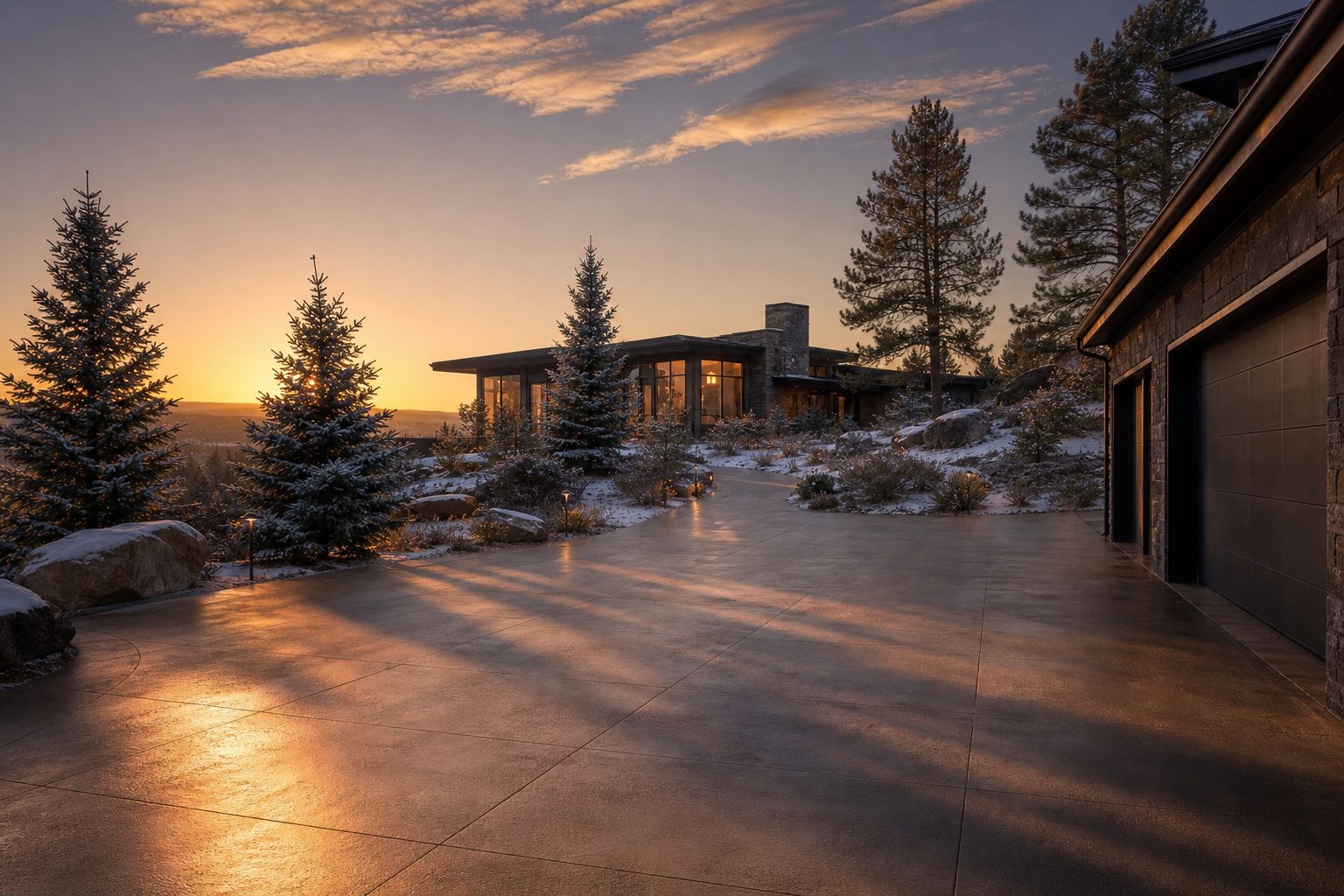
You have probably noticed that many of Douglas County’s most desirable neighborhoods sit on rolling terrain with significant grade changes. Communities in Castle Pines, with wooded lots on hillsides, and elevated parcels throughout Larkspur and Castle Rock present real challenges when winter storms hit at 6,200 to 6,800 feet of elevation.
How Snow-Melt Systems Work
There are two primary types you will encounter:
- Hydronic systems use glycol-heated tubing embedded in concrete or pavers. These are more common in new luxury construction because operating costs are lower on large driveways.
- Electric resistance cable systems are simpler to install but cost more to run over time, making them better suited for smaller areas like walkways or front stoops.
Typical installation costs run $12 to $25 per square foot for hydronic and $8 to $15 per square foot for electric, per industry estimates. For an 800-square-foot driveway, you are looking at a meaningful investment, but one that pays dividends every single winter morning.
So why should you care if you are selling? Because a buyer relocating from Dallas or Los Angeles has no frame of reference for what a steep, icy driveway feels like in January. When that buyer walks into your Castle Pines listing, where the average sold price hit $1,239,295 in Q2 2026 per the Douglas County Economic Development Report, a snow-melt driveway instantly signals that this home was built for Colorado living. It removes an objection they did not even know they had.
Geothermal Heating and Cooling at Colorado’s Elevation
Geothermal heat pump systems leverage the earth’s constant underground temperature (typically 50 to 55 degrees in Colorado) to heat and cool your home with dramatically lower energy consumption than conventional HVAC. At Douglas County’s elevation, where heating demand is significant and air-source heat pumps lose efficiency in extreme cold, geothermal becomes a compelling choice.
What Buyers and Sellers Should Know
- Upfront cost is substantial. Ground-loop installation requires either horizontal trenching or vertical well drilling, which can be costly depending on your lot’s geology and available acreage.
- Operating savings are real. Geothermal systems can reduce heating and cooling costs by 30 to 60 percent compared to conventional systems, according to the U.S. Department of Energy.
- Longevity favors the investment. Ground loops can last 50 or more years, and the heat pump units typically last 20 to 25 years, roughly double a conventional furnace.
For you as a seller, a geothermal system is a feature worth highlighting prominently. Industry data consistently shows that energy-efficient homes attract more buyer attention. For relocation buyers who may be accustomed to mild climates, understanding that your monthly utility costs will be significantly lower with geothermal can be the detail that tips your decision.
What I tell my clients is this: if you are comparing two homes in Highlands Ranch, where the average sold price was $903,531 in Q2 2026 per the Douglas County report, and one has geothermal while the other has a standard 15-year-old furnace, the geothermal home has a measurable operating advantage that compounds every single month you own it.
Radiant Floor Heating for Douglas County Winters
Radiant floor heating, whether hydronic (hot water tubing) or electric, delivers heat from the floor up, creating even warmth without the drafts and noise of forced air. In a market where luxury buyers expect comfort that matches the price point, radiant heat has become a signature feature.
Where Radiant Heat Makes the Biggest Impact
- Primary living areas and kitchens with tile or stone floors. Walking barefoot across heated travertine in January is a sensory experience that conventional HVAC simply cannot replicate.
- Finished basements, which are common in Douglas County’s walkout-lot designs. Basements with radiant heat feel like true living space rather than a chilly afterthought.
- Master bathrooms in the luxury tier. At the Castle Pines luxury market price point, where the middle half of sales close between $789,900 and $1,210,000 per Resideline data, buyers expect heated bathroom floors as a baseline comfort feature.
If you are preparing your Parker or Castle Rock home for sale, having radiant heat documentation (installation records, system specs, maintenance history) ready for buyer review demonstrates both quality and transparency. Rated 5 out of 5 stars by 130 past clients, I always advise sellers to compile a comprehensive mechanical systems folder because that documentation builds buyer confidence faster than any marketing brochure.
Whole-Home Generators: Why Colorado’s Grid Realities Demand Backup Power
You might not think about backup power until the first time your electricity goes out during a December blizzard with 40-mile-per-hour winds. Douglas County sits in a region where severe thunderstorms, high winds, and heavy snowfall can knock out power for hours or even days.
Generator Options for Luxury Homes
- Standby generators (natural gas or propane) are permanently installed and activate automatically within seconds of a power outage. These are the standard for luxury homes in the $1M-plus range.
- Sizing matters. A 22kW generator covers most standard luxury homes. Larger homes, or those with geothermal systems, EV chargers, or heated driveways, may need 30kW to 48kW units.
- Integration with smart home systems allows you to monitor generator status, fuel levels, and maintenance schedules remotely.
For relocation buyers coming from markets where power outages are rare, here is the reality: Colorado’s semi-arid climate and exposure to severe weather events make a whole-home generator not a luxury but a practical necessity at this price tier. When you are paying close to or above the Douglas County median listing price of $775,000 (per FRED data as of April 2026), you expect your home to function perfectly regardless of what is happening outside.
How High-End Mechanicals Affect Your Sale Price and Negotiation Position
If you are a seller in Lone Tree, where the average sold price reached $1,075,125 in Q2 2026 per the Douglas County report, or in Castle Rock at $868,267, the mechanical systems in your home directly influence how buyers perceive value and how aggressively they negotiate.
In a market where nearly half of $1M-plus closings include concessions, having premium mechanicals gives you leverage to resist excessive concession demands. A snow-melt driveway, geothermal HVAC, radiant floors, and a standby generator collectively represent tens of thousands of dollars in installed value and ongoing savings that buyers cannot easily replicate after closing.
What does this look like in practice? It means your listing presentation tells a story of a home engineered for Colorado, not just built in Colorado. That distinction matters enormously to relocation buyers who represent a significant portion of Douglas County’s buyer pool, drawn by employment opportunities in the Denver Tech Center corridor and attracted to top-rated schools throughout the county.
Having closed 469 transactions over 30 years in this market, I can tell you that homes with documented, well-maintained mechanical systems consistently generate stronger offers and smoother inspections.
Frequently Asked Questions
How much does a snow-melt driveway system cost to install in Castle Rock?
Hydronic snow-melt systems typically run $12 to $25 per square foot installed, while electric systems range from $8 to $15 per square foot. Your total cost depends on driveway size, grade, and the system type you choose. For a typical luxury home driveway in Castle Rock or Castle Pines, you should budget accordingly and factor in the long-term convenience and safety benefits.
Does geothermal heating work well at Douglas County’s elevation?
Yes. Geothermal systems actually perform well at elevation because they draw from stable underground temperatures rather than ambient air. The U.S. Department of Energy estimates 30 to 60 percent energy savings versus conventional HVAC. Douglas County’s lot sizes, particularly in Larkspur and Franktown, often provide ample space for ground-loop installation.
Will radiant floor heating increase my home’s resale value in Highlands Ranch?
Radiant heat is a sought-after feature in Douglas County’s luxury market. While exact value-add varies by property, homes with radiant heat in key living areas consistently attract more buyer interest. At Highlands Ranch’s $903,531 average sold price (Q2 2026, per the Douglas County report), buyers expect comfort features that justify the investment.
What size generator do I need for a luxury home in Castle Pines?
Most luxury homes in Castle Pines perform well with a 22kW to 30kW standby generator. If your home includes a geothermal system, EV charger, heated driveway, or extensive smart-home infrastructure, you may need a 36kW to 48kW unit. A qualified electrician should perform a load calculation specific to your home.
Are there tax incentives for geothermal systems in Colorado?
Federal tax credits have historically been available for qualified geothermal heat pump installations. Availability and percentages change year to year, so you should consult a tax professional for current incentive details applicable to your situation in 2026.
How do snow-melt driveways handle Douglas County’s freeze-thaw cycles?
Properly installed hydronic systems handle freeze-thaw cycles effectively because the tubing is embedded in the concrete or paver base and activates via moisture and temperature sensors. The system only runs when conditions require it, which protects both the driveway surface and your utility budget.
Should I install high-end mechanicals before selling my Parker home?
That depends on your home’s price tier and your competition. At Parker’s $833,684 average sold price (Q2 2026, per the Douglas County report), certain upgrades like a standby generator may offer stronger return than a full snow-melt driveway installation. Discussing your specific situation with a knowledgeable local agent is critical.
Do relocation buyers from warm climates care about these systems?
Absolutely. Relocation buyers from markets like Los Angeles or Phoenix often do not understand Colorado’s winter demands until they experience them. Homes with these systems already installed remove uncertainty and make the transition significantly easier, which translates directly into purchase confidence.
How long do these mechanical systems last?
Geothermal ground loops can last 50-plus years, with heat pump units lasting 20 to 25 years. Hydronic snow-melt systems typically last 20 to 30 years. Standby generators last 15 to 25 years with proper maintenance. Radiant floor systems embedded in concrete can last the life of the home.
Can I retrofit these systems into an existing Douglas County home?
Retrofitting is possible but varies in complexity. Standby generators and some radiant heating solutions are relatively straightforward. Geothermal and hydronic snow-melt systems are significantly more complex and costly to retrofit than to include in new construction. A mechanical contractor experienced with Colorado’s soil and climate conditions should evaluate your property.
The Bottom Line
Whether you are selling a luxury home in Castle Pines, moving up within Castle Rock, or relocating to Douglas County from out of state, high-end mechanical systems are no longer optional extras. They are the features that separate well-built Colorado homes from everything else on the market. In a county where the average detached home sold for $895,018 in Q2 2026 and concession pressure is real, these systems give sellers leverage and give buyers lasting comfort, efficiency, and peace of mind.
If you want a clear-eyed assessment of how your home’s mechanical systems affect its market position, or you need guidance on what to look for as a buyer, I would welcome that conversation. With 30 years and 469 transactions in the Denver South Metro market, I bring the experience to help you make confident decisions. Call me, David, at 303-882-7706 or visit DavidRichins.com to get started.