What are the hidden costs when buying a $500K+ luxury lot in Douglas County, including tap fees, bentonite clay soil mitigation, engineering, and retaining walls?
Buying a luxury lot in Douglas County can add $60,000 to $150,000 or more in hidden costs beyond the purchase price, driven by tap fees, bentonite clay mitigation, structural engineering, and retaining wall construction.
Why This Matters Right Now in Douglas County
You found the perfect lot in Castle Pines, Larkspur, or one of Castle Rock‘s newer communities like Macanta. The views are incredible. The price feels right. Then reality shows up in the form of invoices you never anticipated.
Douglas County sits on some of Colorado’s most challenging soil for construction, according to regional landscaping and engineering experts. With the median listing price in Douglas County reaching $775,000 as of April 2026 (per Federal Reserve Economic Data), and luxury lot prices routinely exceeding $500,000 in communities from Castle Pines Village to the Franktown corridor, your land purchase is just the starting line. Having closed over 469 transactions across the Denver South Metro over 30 years, I can tell you the lot price is often the simplest number in the entire equation. What comes after is where budgets get strained, timelines get stretched, and unprepared buyers get burned.
So what exactly should you budget for? Let me walk you through each cost category.
Tap Fees for New Construction in Douglas County Can Exceed $60,000
If you are relocating to Colorado from out of state, tap fees will likely be the first shock. In many parts of the country, connecting to water and sewer costs a few thousand dollars. In Douglas County, that number can be dramatically higher.
Colorado’s water districts operate independently, and Douglas County is served by multiple districts, each with its own fee structure. Key districts include Castle Rock Water, Parker Water and Sanitation District, Centennial Water and Sanitation District (serving Highlands Ranch), Castle Pines Metropolitan District, and the Pinery Water and Wastewater District covering the Elizabeth and Franktown areas.
Tap fees in Douglas County commonly range from $20,000 to $50,000 or more for a single-family residential connection, depending on the district and lot size. In luxury lot areas in unincorporated Douglas County or Castle Pines Village, combined water and sewer tap fees can exceed $60,000 to $80,000 when you factor in augmentation fees, raw water dedication requirements, and infrastructure surcharges, according to Douglas County government data.
What does that actually mean for your bottom line? If you are buying a $600,000 lot in the Franktown area and planning a custom build, your tap fees alone could add 10 to 13 percent to your land cost before a single shovel hits the dirt.
Here is what you need to do before you close on any lot:
- Call the specific water district serving that parcel and request a current fee schedule
- Ask about pending fee increases, as many districts adjust annually
- Clarify whether tap fees are included in the lot price (in some master-planned communities, they are; in most raw land sales, they are not)
- Confirm whether the lot already has water rights dedicated to it, or whether you will need to purchase them separately
Bentonite Clay Soil Mitigation in Colorado Is the Biggest Budget Risk
This is the cost category that catches the most people off guard, and it is the one that can cause the most financial damage if ignored.
Douglas County sits squarely on Colorado’s Front Range geology, which includes the Denver Blue Bentonite and Pierre Shale formations. According to Copper Homes, a Colorado builder, pure bentonite can expand up to 15 times its original size when it absorbs water. Even when mixed into surrounding soil, expansion typically reaches about 25% above dry volume.
Why does that matter for your luxury lot? Because expanding clay can exert up to 30,000 pounds of force per square foot, according to Colorado Horse Property’s soil analysis resources. That pressure bows basement walls, snaps concrete slabs, and lifts entire structures. Nationally, expansive soils cause more financial loss than floods, hurricanes, tornadoes, and earthquakes combined.
Mitigation is not optional in Douglas County. It is essential. According to Copper Homes, mitigation efforts typically add $20,000 to $50,000 to your construction costs. On a luxury build where you are investing $800,000 or more in the structure, that represents a meaningful addition to your budget, but skipping it could result in foundation failure that costs far more to repair.
Common mitigation strategies include:
- Over-excavation and replacement of expansive soil beneath the foundation with engineered fill
- Structural void forms beneath grade beams that allow soil to expand without transferring pressure to the foundation
- Moisture barriers and drainage systems designed to keep water away from the clay layer
- Pier and beam foundation systems that bypass the expansive soil layer entirely
What I tell my clients is this: the mitigation cost is not a line item to negotiate away. It is the single most important investment in your home’s long-term structural integrity.
Engineering Costs in Castle Rock and Castle Pines Add Up Fast
Before you can design a foundation that handles Douglas County’s soil, you need professional engineering. This involves multiple phases, and each carries its own cost.
Geotechnical Soil Reports
A geotechnical soil report is your first step and costs $400 to $800, according to Constructly Tools. This report tells your builder exactly what soil conditions exist on your specific lot, including the type of clay present, the swell potential, moisture levels, and load-bearing capacity. Every lot is different, even within the same subdivision.
Foundation Inspections and Structural Engineering
According to Go2 Inspection, a standalone foundation inspection in the Denver metro runs between $400 and $900. Homes in the Castle Rock area sometimes cost more due to larger average home sizes and the prevalence of bentonite clay conditions, per Go2 Inspection’s analysis.
If you need a full structural engineer’s assessment, expect $150 to $350 per hour, or $500 to $2,500 as a flat fee, according to ISTA Engineers. A combined inspection with soil testing runs $1,000 to $3,000 or more. This includes elevation surveys, crack mapping, moisture readings, load analysis, and a stamped Professional Engineer report.
Concrete Work in Bentonite Zones
For concrete slab work specifically, the Castle Rock and Parker areas run $8 to $13 per square foot due to Douglas County’s growth demand and the extra base preparation required for bentonite conditions, per Constructly Tools. Standard rebar specification for Denver bentonite conditions is number 4 rebar on 18-inch centers, with gravel base and prep adding $400 to $900 for a compacted base.
With 30 years of experience in this market and 130 five-star reviews from past clients, I have seen what happens when buyers try to save a few thousand dollars by cutting corners on engineering. The repair bills that come three to five years later dwarf the original savings.
Retaining Walls on Douglas County Slopes Are a Major Investment
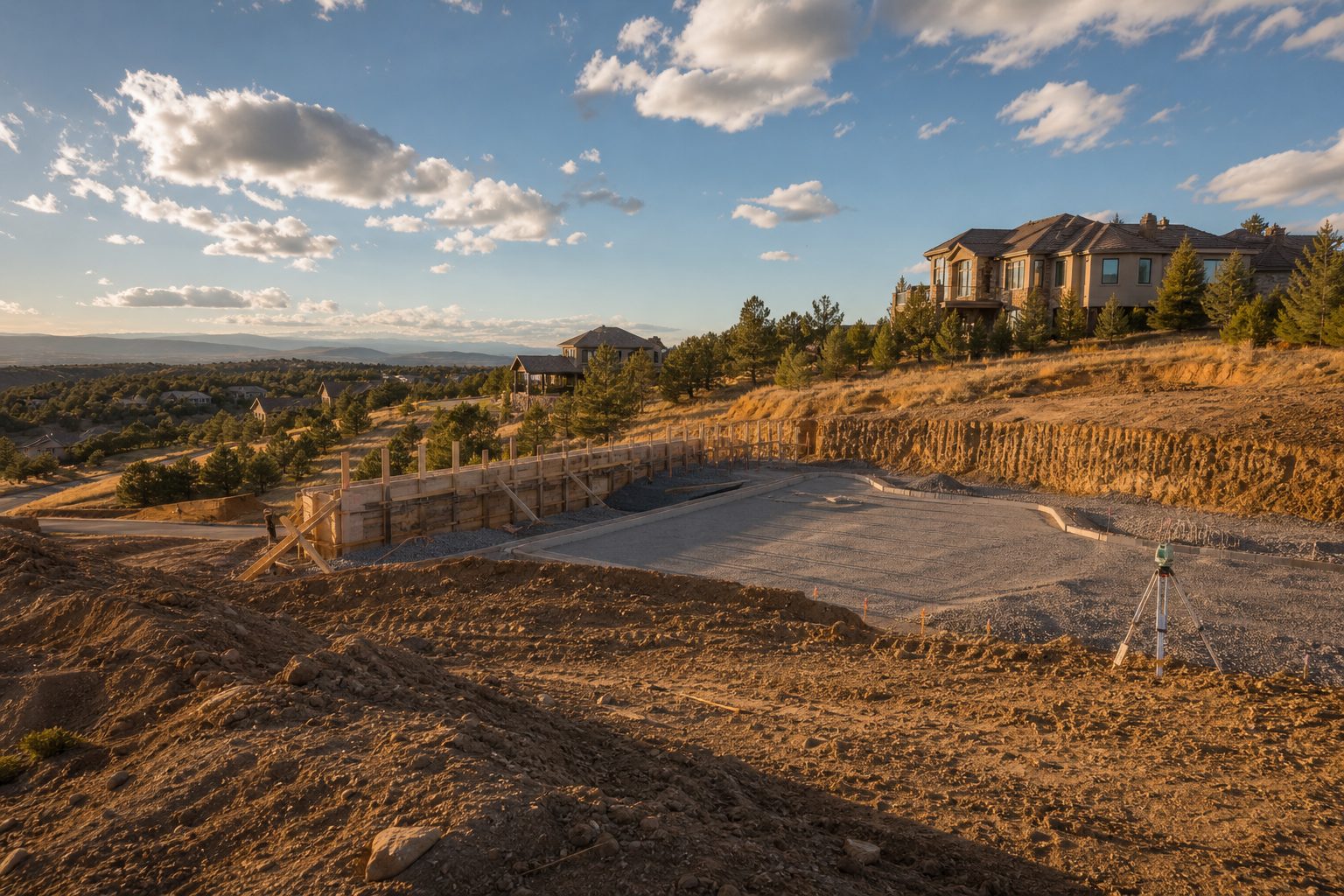
Douglas County’s terrain is one of its greatest attractions and one of its most expensive construction challenges. Those rolling hills, canyon views, and dramatic elevation changes throughout Castle Pines, Larkspur, and the western portions of Castle Rock mean many luxury lots require retaining walls.
Colorado’s Front Range is notorious for expansive clay soils, and Douglas County is no exception, according to Douglas County landscaping experts. These soils expand when wet and contract when dry, creating movement that can destroy improperly built retaining walls.
The cost of retaining walls on a luxury lot depends on several factors:
- Wall height and length: a 4-foot decorative wall is a completely different budget item than a 12-foot structural wall
- Engineering requirements: walls over 4 feet typically require engineered plans and permits
- Drainage integration: proper drainage behind and around the wall is critical in clay soils
- Material selection: segmental block, poured concrete, and boulder walls each carry different price points
- Site access: steep or remote lots can significantly increase labor and equipment costs
On luxury lots in communities like Castle Pines Village, the Ridge at Castle Pines, or the hillside parcels along the Larkspur corridor, retaining wall costs can range from $15,000 for a modest installation to well over $100,000 for extensive multi-tiered structural walls on steep terrain.
How to Protect Yourself Before Buying a Douglas County Luxury Lot
You can avoid the worst financial surprises by taking a few deliberate steps before you close on any lot priced above $500,000 in the Denver South Metro.
- Get the geotechnical report before closing whenever possible, not after
- Contact the water district directly and get written fee confirmation
- Walk the lot with a grading contractor to evaluate retaining wall needs
- Budget a contingency of at least 15 to 20 percent above your estimated build cost for soil-related and site-development surprises
- Ask neighboring property owners about their build experiences, particularly regarding soil conditions
- Work with a real estate professional who specializes in luxury lots in Douglas County and understands the specific cost variables by neighborhood
The difference between Castle Rock’s eastern corridor and a hillside lot in Larkspur can be tens of thousands of dollars in site prep alone. Having helped buyers and sellers close 469 transactions across the Denver South Metro, I know which neighborhoods carry which risks, and that local knowledge saves real money.
Frequently Asked Questions
How much are tap fees in Castle Rock, Colorado?
Tap fees vary by water district, but in the Castle Rock area, combined water and sewer tap fees commonly range from $20,000 to $50,000 or more for a single-family connection, according to Douglas County government data. Some luxury parcels in unincorporated areas can see fees exceeding $60,000 to $80,000 when augmentation and raw water dedication costs are included.
What is bentonite clay and why does it matter for Douglas County homebuilders?
Bentonite is a type of clay mineral, specifically montmorillonite, that expands dramatically when it absorbs water. According to Copper Homes, pure bentonite can expand up to 15 times its original size. Douglas County sits on Front Range formations that contain this clay, and building without proper mitigation can lead to severe structural damage.
How much does bentonite clay soil mitigation cost in Colorado?
According to Copper Homes, mitigation efforts for expansive soil typically add $20,000 to $50,000 to your construction costs. The exact amount depends on the severity of the clay conditions on your specific lot and the mitigation strategy your engineer recommends.
Do I need a geotechnical soil report before building in Douglas County?
Yes. A geotechnical soil report costs $400 to $800, per Constructly Tools, and it is the essential first step before designing your foundation. Every lot has unique soil conditions, even within the same subdivision, and this report tells your builder exactly how to engineer the foundation.
How much force can expanding clay exert on a foundation?
According to Colorado Horse Property’s soil analysis resources, expanding clay can exert up to 30,000 pounds of force per square foot. ISTA Engineers notes swell pressures exceeding 10,000 pounds per square foot when clay is saturated. Either figure is more than enough to crack slabs, bow walls, and lift structures.
Are retaining walls required on luxury lots in Castle Pines?
Not every lot requires retaining walls, but many do because of the hilly terrain. Lots in communities like the Village at Castle Pines, the Ridge at Castle Pines, and hillside parcels along the Larkspur corridor frequently require engineered retaining walls, which can cost anywhere from $15,000 to over $100,000.
What does a structural engineer cost for a luxury build in Castle Rock?
According to ISTA Engineers, a structural engineer typically charges $150 to $350 per hour, or $500 to $2,500 as a flat fee. A combined inspection with soil testing can run $1,000 to $3,000 or more. Castle Rock properties sometimes cost more due to larger home sizes and prevalent bentonite conditions, per Go2 Inspection.
Are tap fees ever included in the lot purchase price in Douglas County?
In some master-planned communities, tap fees are included in the lot price or rolled into the builder’s package. In most raw land and custom lot sales, they are not. You need to ask explicitly and get written confirmation before closing.
What is the total hidden cost I should budget beyond the lot price?
For a luxury lot in Douglas County priced above $500,000, you should budget a minimum of $60,000 to $150,000 or more in additional site-development costs, covering tap fees, soil mitigation, engineering, and potential retaining walls. The exact total depends on your specific lot’s location, soil conditions, and topography.
How do I find out which water district serves a specific Douglas County lot?
You can contact Douglas County government directly or ask your real estate agent to verify the serving water district for any parcel. Each district has its own fee schedule, and rates can change annually, so getting current written confirmation is essential.
The Bottom Line
Buying a luxury lot in Douglas County is an exciting investment, but the purchase price on the listing sheet is genuinely just the beginning. Between tap fees that can exceed $60,000, bentonite clay mitigation adding $20,000 to $50,000, engineering costs climbing into the thousands, and retaining walls that can reach six figures on steep terrain, you need a clear-eyed budget before you commit.
The good news is that these costs are predictable when you do your homework upfront. That means getting soil reports before closing, calling the water district directly, and working with professionals who know Colorado real estate challenges neighborhood by neighborhood. If you are considering a luxury lot purchase in Castle Rock, Castle Pines, Franktown, Larkspur, or anywhere in the Denver South Metro, I would welcome the chance to walk you through what to expect on any specific parcel. You can reach me, David, at 303-882-7706 or through DavidRichins.com. With 30 years and 469 closed transactions across this market, helping buyers avoid costly surprises is one of the things I do best.