What do buyers need to know about well water and water rights when purchasing property in Franktown and Larkspur?
If you are buying acreage in Franktown or Larkspur, your water supply likely comes from a private well, and Colorado law strictly controls what you can do with that water. Understanding well permit types, legal water uses, and due diligence steps before you close is not optional here.
Why Well Water and Water Rights Matter in Franktown Right Now
Colorado’s water law operates on a principle that surprises nearly every out-of-state buyer: “first in time, first in right.” According to the Colorado Division of Water Resources, the state’s prior appropriation system means water rights are treated as property, separate from the land itself, and diverting or storing water without proper authorization carries severe penalties. This is not a technicality. It shapes what you can legally do on your property every single day.
Franktown is the priciest community in Douglas County, with a median listing home price of $1,300,000, per recent market data. At that price point, buyers understandably assume the property can support whatever lifestyle they envision. But in Franktown, where most properties rely on private wells and septic systems, your water permit type determines whether you can irrigate a pasture, water horses, or even run an outdoor spigot. With 30 years of experience and 469 closed transactions across the Denver South Metro, I can tell you that well water confusion is one of the most common and costly mistakes buyers make in this corridor.
How Colorado Water Law Differs From What You Are Used To
If you are relocating to Colorado from another state, here is the single biggest adjustment you need to make: you do not automatically own the rights to water on your property just because you own the land. Colorado’s appropriation system, as described by the Colorado Division of Water Resources, requires that anyone diverting or storing water obtain either a water right, a well permit, or approval of a water replacement plan through the designated water court or the State Engineer’s Office.
What does that actually mean for your daily life on a Franktown or Larkspur property? It means collecting rainwater in barrels, building a small pond, or even catching snowmelt runoff can be illegal without the right permits. Enforcement is active, and penalties are real. This is the kind of detail that does not show up in a listing description but can completely reshape your plans for the property.
So before you fall in love with a 20-acre parcel along the Castle Rock to Franktown corridor, you need to understand exactly what the well permit allows and what additional water rights, if any, come with the land.
The Three Well Permit Types You Will Encounter in Franktown
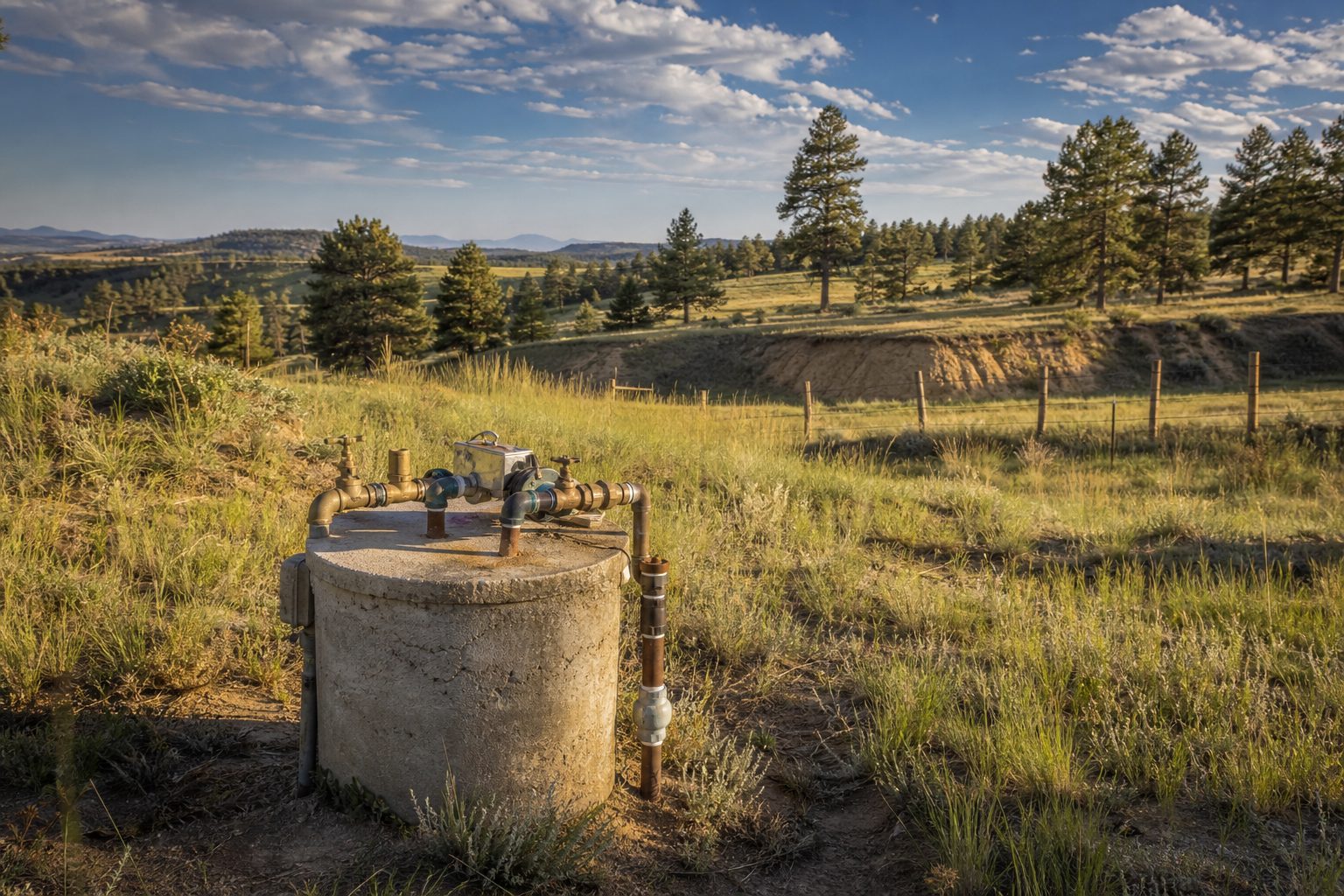
Not all wells are created equal in Colorado. The type of well permit attached to a property dictates what you can legally do with the water, and the distinctions are significant.
Domestic Wells (35 or More Acres)
If the property sits on 35 or more acres, it may have a domestic well permit. This is the most flexible well type. According to Colorado well permit guidelines, a domestic well can supply water to the household, provide water for animals, and irrigate up to one acre of land for a garden or lawn. This well type is exempt from Colorado’s priority system of water rights. For equestrian buyers eyeing Franktown’s horse properties, this distinction is critical.
Household Wells (Under 35 Acres)
If the property has less than 35 acres, it likely has a household well permit. Here is where buyers get tripped up: a household well can only supply water to the home itself. No outdoor watering. No irrigation. No animals. This well type is also exempt from the priority system, but its restrictions are far more limiting than most buyers expect.
Grandfathered Wells
A grandfathered well is one that was in use before 1976. It is exempt from the 35-acre rule and should be recorded with the state water board. These wells can offer more flexibility, but verifying the documentation is essential during your due diligence period.
Why does this matter so much? Franktown’s zoning includes A-1 agricultural land (generally 35 acres and larger), LRR large rural residential (9-plus-acre lots), and RR rural residential (starting at 2 acres with well and septic). If you are buying a 10-acre RR parcel marketed for horses and it carries a household well permit, you cannot legally water those horses from that well. Having guided hundreds of buyers through Douglas County transactions over three decades, this is one of the first things I flag when clients consider rural acreage.
Your Franktown Well Water Due Diligence Checklist
Franktown has 994 total water structures, including 482 water wells, 15 ditches, 10 springs, and 6 reservoirs, according to Colorado water infrastructure data. With that many wells in the area, conditions vary widely from property to property.
Here is what you need to review before closing on any Franktown or Larkspur acreage property:
- Well permit and legal water uses on file with the Colorado Division of Water Resources
- Domestic use allowance versus household-only restrictions
- Livestock watering rights and irrigation rights, if relevant to your plans
- Pump age, well depth, and static water level
- Pump test results, flow rate, and recovery rate
- Water quality testing and any existing treatment systems
- Maintenance records for the well and any associated equipment
- Shared well agreements, if the well serves more than one property
- Colorado Division of Water Resources records confirming the permit matches the seller’s representations
Douglas County requires proof of adequate water supply for building permits, including a well test showing at least 1 gallon per minute. If the flow is lower, a cistern system may be required. Do not skip this step, even if the seller assures you the well “has always worked fine.”
What Larkspur Buyers Need to Know About Water Supply
Larkspur presents a different picture than Franktown. The Town of Larkspur, located off Interstate I-25 between Castle Rock and the Tri-Lakes area, operates a community water supply system that serves roughly 275 residents, sourcing drinking water from three groundwater wells drilled into the Denver Basin Aquifer System.
If you are buying within the town limits, you may be on the municipal system. But many properties in the surrounding unincorporated Larkspur area still rely on private wells, and the same permit rules that apply in Franktown apply here. You need to verify whether the specific property you are considering connects to Larkspur’s municipal system or depends on a private well before you even schedule an inspection.
Larkspur has a median estimated home value of $946,092 at $262 per square foot. At that price level, you deserve complete clarity on your water situation before you commit.
How Well Water Issues Affect Your Franktown Home’s Value and Resale
If you are a move-up seller in Douglas County considering a transition to Franktown or Larkspur acreage, or if you currently own in one of these communities and plan to sell, the well situation directly impacts your property’s marketability. Buyers today are more informed and more cautious. With 130 five-star reviews from past clients, I have learned that the sellers who prepare their well documentation in advance, including permit verification, recent water quality tests, and pump inspections, consistently attract stronger offers and fewer last-minute surprises.
Douglas County’s median closed price was $715,000 as of April 2026, down 1.4% year over year, per Colorado Association of Realtors data. In a market where seller concessions appeared in 62.9% of all Denver metro closings during Q2 2026 (per Chicago Title of Colorado data covering 12,029 transactions), a well problem discovered during inspection can easily cost you $10,000 or more in renegotiation, delays, or lost buyers.
Frequently Asked Questions
Can you water horses with a household well in Franktown?
No. A household well permit in Colorado restricts water use to the home itself. No outdoor watering, irrigation, or animal use is permitted. If you plan to keep horses or livestock, you need a domestic well on 35 or more acres, a grandfathered well, or separate water rights that authorize livestock watering. Verify the permit type before making an offer.
Is it legal to collect rainwater on your Franktown property?
Colorado has historically restricted rainwater collection. Diverting or storing water, including catching rain runoff or snowmelt, is illegal without proper authorization, according to the Colorado Division of Water Resources. Some limited residential exceptions exist under Colorado law, but you should confirm current rules with the State Engineer’s Office before installing any collection system.
How deep are wells in the Franktown area?
Well depths in Franktown vary significantly depending on the specific location and the aquifer being tapped. Your due diligence should include reviewing the well depth, static water level, and pump test results documented in the Colorado Division of Water Resources records. Do not rely on verbal estimates from the seller.
What is the minimum well flow rate required in Douglas County?
Douglas County requires proof of adequate water supply for building permits, including a well test showing at least 1 gallon per minute. If the flow rate falls below that threshold, the county may require installation of a cistern system to ensure reliable water supply to the property.
Do water rights transfer automatically when you buy property in Franktown?
Not necessarily. In Colorado, water rights can be owned separately from the land. You need to confirm during due diligence whether any water rights are included with the sale and whether they are properly documented with the water court. Never assume they transfer automatically.
What happens if a well runs dry on a Franktown property?
If your well runs dry, you are responsible for drilling a new well or arranging an alternative water supply, such as a cistern with hauled water. This can be expensive and time-consuming. Reviewing the well’s flow rate, recovery rate, and the aquifer conditions before purchase helps you assess this risk.
Does Larkspur have municipal water service?
The Town of Larkspur operates a community water supply system serving approximately 275 residents from three groundwater wells drilled into the Denver Basin Aquifer System. However, many properties in unincorporated areas surrounding Larkspur rely on private wells. Confirm the specific property’s water source early in your search.
How do shared well agreements work in Franktown?
Some Franktown properties share a well with neighboring parcels under a recorded shared well agreement. These agreements outline each party’s rights, maintenance responsibilities, and cost-sharing arrangements. Review any shared well agreement carefully with your attorney before closing, as disputes between neighbors can be difficult to resolve.
Can you irrigate a garden with a household well in Colorado?
No. A household well permit restricts use to indoor household purposes only. If you want to irrigate even a small garden, you need a domestic well permit (which requires 35 or more acres) or a grandfathered well with broader permitted uses. This catches many buyers off guard.
Should you get a well inspection before buying acreage in Franktown?
Absolutely. A well inspection should include flow rate testing, recovery rate measurement, water quality analysis, pump condition assessment, and verification that the well permit matches the seller’s claims about permitted uses. This is one of the most important parts of buying acreage in the Franktown area.
The Bottom Line
Buying acreage in Franktown or Larkspur is one of the most rewarding moves you can make in the Denver South Metro, but your water situation demands serious attention before you sign anything. Colorado water law is unlike any other state, well permit types dictate what you can legally do on your land, and skipping due diligence can cost you tens of thousands of dollars after closing.
With 30 years of experience as a Castle Rock real estate agent and 469 closed transactions across Douglas County, I help buyers navigate exactly these complexities every week. If you are considering a move to Franktown, Larkspur, or anywhere in the South Metro, call me at 303-882-7706 or visit DavidRichins.com. Let’s make sure you understand every detail about the property before you commit.